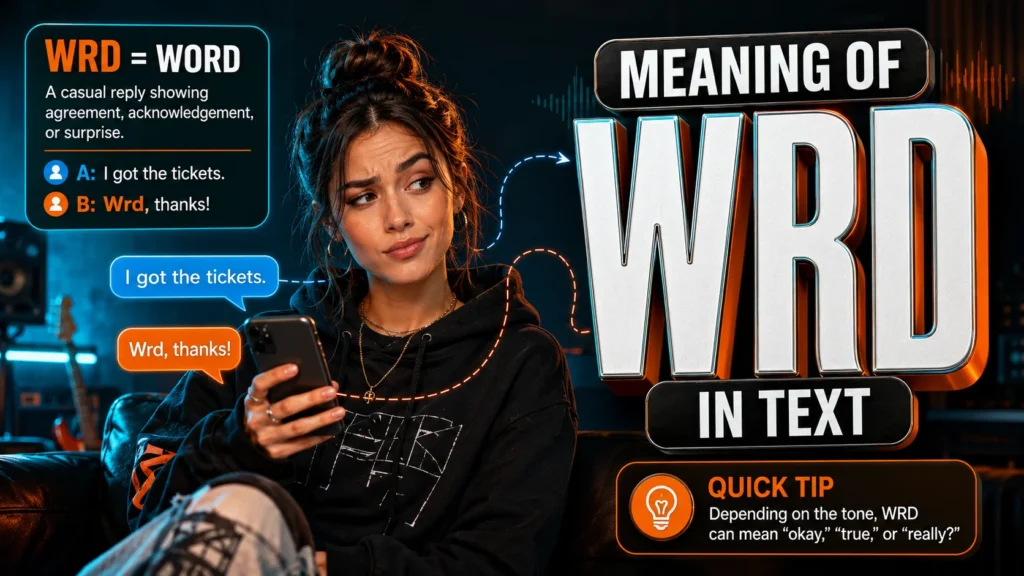
WRD means “word” in text messages. When someone texts it to you, they usually mean “I agree,” “that’s true,” “I understand,” or “really?” The correct interpretation depends on the message, tone, and punctuation surrounding it.
People search for the meaning of WRD in text because “word” appears to be missing a vowel and its slang function is not immediately obvious. WRD can confirm a plan, acknowledge information, support an opinion, or react with surprise. It rarely refers to a literal vocabulary word when sent by itself.
What Does WRD Mean in Text?
WRD is a shortened spelling of “word.” Unlike abbreviations such as BRB or LOL, its letters do not represent three separate words:
W + R + D = Word without the vowel “o”
Removing vowels is a common form of informal digital shorthand. It allows the sender to type quickly while keeping enough consonants for the reader to recognize the original word.
In texting slang, WRD can mean:
- I agree
- That’s true
- Exactly
- I understand
- Okay
- Really?
- Are you serious?
- That sounds good
- I respect that
- I accept the plan
Agreement is its most common function, but punctuation and context can turn it into a question or surprised reaction.
WRD Meaning “I Agree”
The most common meaning of WRD is “I agree” or “that’s true.” It shows that the sender supports what another person has said.
A: That restaurant is much better on weekdays.
B: Wrd, it gets too crowded on Saturday.
A: Exactly, and the service is slower.
B: Tuesday evening would be better.
In this conversation, “wrd” means “I agree with you.”
It can respond to an opinion, recommendation, observation, or complaint. The message is usually positive or neutral rather than argumentative.
WRD Meaning “I Understand”
WRD can acknowledge information in the same way as “okay,” “got it,” or “understood.”
A: Meet me outside the library at four.
B: Wrd. I’ll be there.
A: Message me if you’re running late.
B: Will do.
Here, WRD confirms that the sender has read and accepted the plan. It does not necessarily express enthusiastic agreement; it simply communicates understanding.
This use can sound brief, so it works best between people who already use casual language.
WRD Meaning “That’s True”
WRD may confirm that a statement is accurate. In this sense, it is close to “facts,” “true,” or “exactly.”
A: People always underestimate how long that journey takes.
B: Wrd, traffic adds at least thirty minutes.
A: We should leave early tomorrow.
B: Definitely.
The sender uses WRD to validate the first person’s observation.
WRD Meaning “Really?” or “Are You Serious?”
When WRD includes a question mark, it may express surprise or request confirmation:
- “wrd?”
- “WRD?”
- “wrd??”
- “oh wrd?”
These forms often mean:
- Really?
- Is that true?
- Are you serious?
- For real?
- You actually mean that?
For example:
A: I got two free tickets for Friday.
B: Wrd??
A: Yes, my cousin can’t use them.
B: That’s amazing. I’m free!
The surprising information and double question marks show that WRD is a question, not simple agreement.
WRD Meaning “Okay” or “Sounds Good”
WRD can accept a suggestion or confirm a plan:
A: I’ll pick you up around seven.
B: Wrd, I’ll be ready.
A: We can eat before the film.
B: Sounds good.
In this context, WRD means “okay,” “all right,” or “that works for me.”
Can WRD Mean “What’s the Word?”
WRD alone generally means “word,” not “What’s the word?” The common abbreviation for “What’s the word?” is WTW.
However, someone might send “wrd?” as a very compressed way of asking for an update. This use is highly contextual and less clear than WTW.
Compare:
- “WTW tonight?” — What’s the word or what’s the plan tonight?
- “Wrd.” — Okay, I agree, or I understand.
- “Wrd?” — Really? Is that true?
- “What’s the wrd?” — What is the update or plan?
Do not automatically expand WRD into a multiword phrase. In most chats, it is simply “word” with the vowel removed.
Meaning of WRD Across Texting Platforms
WRD in SMS and iMessage
In ordinary SMS and iMessage conversations, WRD usually communicates agreement, understanding, or acceptance.
Someone might respond “wrd” after you provide a meeting time, share an opinion, or explain a situation. A question mark changes the likely meaning to “really?”
Examples include:
- “Wrd, I agree.”
- “Okay wrd, see you then.”
- “Wrd? You actually won?”
- “That’s the best song on the album.” — “Wrd.”
WRD on WhatsApp
WRD has the same primary meaning on WhatsApp. In individual chats, it can acknowledge information. In groups, it may support another member’s opinion without repeating the whole point.
For example:
A: Let’s submit everything before Thursday.
B: Wrd. Waiting until Friday is risky.
C: Agreed. I’ll finish my section tonight.
A: Perfect.
WRD operates as a compact vote of agreement.
WRD in Instagram and Snapchat DMs
Instagram and Snapchat users may send WRD as a quick reaction to a Story, message, opinion, or plan.
If someone replies “wrd” to your complaint, they probably mean “I understand” or “that’s true.” If they send “wrd?” after surprising news, they are asking whether you are serious.
WRD is not automatically flirty on either platform. Any romantic tone comes from the surrounding conversation.
WRD on Discord
On Discord, WRD may acknowledge game plans, confirm instructions, or agree with an opinion. Its brevity suits fast conversations where several messages arrive close together.
For example, “Meet in the lobby in five” followed by “wrd” means “understood” or “okay.”
WRD on TikTok and X
WRD can appear in TikTok comments and X replies to express agreement. In this setting, it works like “facts,” “exactly,” or “true.”
A standalone “wrd” under an opinion generally signals support. “Wrd?” under a surprising claim requests evidence or confirmation.
Because public comments may lack context, the tone is sometimes difficult to determine.
Capitalization, Punctuation, and Variations
Common forms include:
- wrd
- WRD
- Wrd
- wrd.
- wrd?
- wrd??
- oh wrd
- wrddd
- word
- word up
Capitalization does not officially alter the definition, but styling can affect tone.
Lowercase “wrd”
Lowercase “wrd” is the most relaxed form. It often shows casual agreement or acknowledgment:
“wrd, I’ll be there.”
Uppercase “WRD”
Uppercase WRD may add emphasis:
“WRD! That’s exactly what I said.”
It can also look more surprised when followed by punctuation:
“WRD?? You got accepted?”
“Wrd.” With a Period
A period can make the reply appear firm, final, or emotionally distant:
A: I’m not changing my decision.
B: Wrd.
Depending on the relationship, this may mean “understood” with little interest in continuing the discussion.
“Wrd?” With a Question Mark
A question mark turns WRD into a request for confirmation:
“Wrd?” = “Really?” or “Are you serious?”
Extended “Wrddd”
Extra letters usually add enthusiasm or playful emphasis:
“Wrddd, that outfit looks amazing.”
This is a spelling variation, not a separate slang term or meaning.
How Tone Changes the Meaning of WRD
Funny Tone
A: I’m starting my diet tomorrow.
B: You said that while holding three doughnuts.
A: They’re my farewell meal.
B: Wrd 😂 Very emotional goodbye.
WRD playfully acknowledges the excuse without treating it seriously.
Sarcastic Tone
A: I only arrived forty minutes late.
B: Wrd, practically early for you.
A: I knew you’d understand.
B: That was not a compliment.
Here, WRD introduces sarcastic agreement.
Playful Tone
A: I make the best pancakes in the family.
B: Wrd? That’s a confident statement.
A: Come over tomorrow and I’ll prove it.
B: Challenge accepted.
The question mark makes WRD mean “Really?” while keeping the tone light.
Serious Tone
A: I need some space tonight. I’m overwhelmed.
B: Wrd, I understand.
A: Thank you for not taking it personally.
B: Message me whenever you’re ready.
WRD communicates acknowledgment, but the additional sentence prevents it from sounding dismissive.
Realistic WRD Conversations
Between Friends
A: That café closes earlier on Sundays.
B: Wrd, I forgot about that.
A: We could meet at the one near campus instead.
B: Good idea.
Meaning: That’s true or I understand.
Between Romantic Partners
A: I don’t want us to argue over text.
B: Wrd. We should talk properly later.
A: Can I call after work?
B: Yes, I’ll be free.
Meaning: I agree.
Between Coworkers
A: I uploaded the final spreadsheet to the shared folder.
B: Wrd, I’ll review it before the meeting.
A: Let me know if any totals look wrong.
B: I will.
Meaning: Understood. This is informal and best reserved for a familiar coworker.
Between a Parent and Adult Child
A: The roads are supposed to be icy tonight.
B: I’ll leave before it gets dark.
A: Please message me when you arrive.
B: Wrd, I will.
Meaning: Okay or understood.
Between Siblings
A: Mum said we can use her car this weekend.
B: Wrd??
A: Yes, as long as we fill the tank.
B: I genuinely didn’t expect that.
Meaning: Really? or are you serious?
With a New Online Contact
A: That game becomes much easier after level ten.
B: Wrd? I’m stuck on level eight.
A: Keep the resources for the next upgrade.
B: Thanks, I’ll try that.
Meaning: Really? The sender wants confirmation.
Together with the four tone examples, these provide ten realistic WRD conversations across different relationships.
Grammar and Language Role of WRD
WRD is a consonant-only shortened spelling of the noun “word.” In slang use, it functions most often as an interjection or discourse marker rather than a conventional noun.
As an interjection, it can form a complete reply:
A: We’re leaving at six.
B: Wrd.
It may also appear at the beginning of a longer message:
- “Wrd, I agree.”
- “Wrd, that makes sense.”
- “Wrd? When did that happen?”
- “Oh wrd, I didn’t know.”
- “Wrd bro, I’ll handle it.”
It can appear at the end, although this construction is less common:
- “That’s exactly what happened, wrd.”
- “I’ll meet you there, wrd.”
WRD cannot always replace the ordinary noun “word.” In formal writing, “I learned a new wrd” is merely a misspelling or informal shortening. The slang meaning depends on WRD functioning as a response or conversational marker.
Its register is highly informal. Avoid it in essays, formal emails, reports, applications, customer messages, and communication with people who may not understand slang.
How to Reply to WRD
Funny Reply
“Wrd indeed—the council has spoken 😂”
This matches a playful agreement.
If the sender writes “wrd?” after surprising news, you could reply:
“Very wrd. I have screenshots to prove it.”
Serious Reply
“Yes, I’m serious. I received the confirmation this morning.”
This directly answers WRD meaning “Really?”
When WRD means agreement, a serious response could be:
“Thank you for understanding. I appreciate it.”
Flirty Reply
“Wrd? I guess you’ll have to see for yourself 😉”
Use a flirty response only when the existing conversation is clearly romantic and mutually comfortable.
Neutral or Unbothered Reply
“Yeah, exactly.”
This works when WRD expresses agreement.
If it means “really?”, respond with:
“Yeah, it’s true.”
When No Reply Is Needed
WRD sometimes closes a minor exchange:
A: See you at eight.
B: Wrd.
The first sender does not necessarily need to reply. However, It has already confirmed the arrangement.
Compared With Related Texting Terms
| Term | Meaning | Usage Context | Tone | Popularity | Confusion Risk |
|---|---|---|---|---|---|
| WRD | Word; I agree, understood, or really? | Agreement, acknowledgment, surprise | Casual | Moderate | Medium |
| WORD | Agreement, truth, or acknowledgment | Spoken language and texting | Casual | Moderate | Medium |
| FR | For real | Strong agreement or confirmation | Casual and emphatic | Very high | Low |
| FAX | Facts | Agreeing that something is true | Supportive | Moderate | Medium |
| BET | Okay, agreed, or challenge accepted | Confirming plans or accepting a statement | Confident and casual | High | Medium |
| IK | I know | Acknowledging information already understood | Neutral or dismissive | High | Low |
| CAP | A lie or false claim—the opposite of confirming truth | Disagreement or accusation | Challenging | High | Medium |
WRD and FR can both request confirmation. “Wrd?” means “Really?”, while “FR?” means “For real?” Their practical functions are similar, although WRD also communicates ordinary agreement and acknowledgment.
Who Uses WRD?
Teenagers and Young Adults
WRD is especially visible among teenagers and young adults using fast, informal messaging. Its short form is useful in DMs, group chats, gaming conversations, and comments.
Not every young person uses or recognizes it. Digital slang varies considerably between social circles.
Gen Z Versus Millennials
Gen Z users may prefer the vowel-free “wrd,” particularly in lowercase and without punctuation. They may use it in the same conversational position as “fr,” “facts,” or “bet.”
Millennials may be more familiar with the complete slang expression “word” or “word up,” although many also recognize WRD. These are tendencies rather than universal generational rules.
Regional Usage
The slang use of “word” is strongly associated with informal American English and spread widely through Black American speech, hip-hop, music, film, and youth culture. The shortened spelling WRD later became common in digital conversations.
Online exposure means WRD may now be understood in the UK, Canada, Australia, and other English-speaking communities. Familiarity is not equal across all regions, however, and the abbreviation may confuse people who know only the ordinary dictionary meaning of “word.”
Origin and Internet Culture
WRD comes from the slang use of “word,” not from a modern three-word acronym. “Word” developed functions expressing truth, agreement, acknowledgment, and affirmation in Black American speech and hip-hop culture.
Expressions such as “word,” “word up,” and “word is bond” helped establish the idea that a person’s “word” represented truth, sincerity, or commitment. Hip-hop music and popular culture brought these expressions to a broader audience during the late twentieth century.
The exact origin of “word” as an agreement marker cannot be credited confidently to one person. It is important to recognize its Black American cultural associations without reducing a diverse speech tradition to an internet trend.
“Word up” gained significant mainstream visibility through Cameo’s 1986 song “Word Up!” Dictionary.com describes the phrase as expressing agreement, approval, or excitement. The consonant-only spelling “wrd” is a later digital compression shaped by texting and social-media habits.
WRD was not invented by TikTok. TikTok, Snapchat, Instagram, and other platforms helped circulate the shortened spelling, but the slang function of “word” predates them.
Is WRD Rude or Offensive?
WRD is not profanity and is not inherently rude or offensive. It generally communicates agreement, understanding, or surprise.
However, an extremely short response can appear dismissive in a serious conversation:
A: I spent all day fixing the problem.
B: Wrd.
The reply may sound as though the sender does not care. Adding “I understand” or “thank you” would communicate greater empathy.
Is WRD Appropriate at School?
WRD is harmless in private messages between classmates. It should not be used as standard spelling in essays, examinations, applications, or messages to teachers.
Use “I agree,” “I understand,” or “Is that true?” in formal school communication.
Is WRD Appropriate at Work?
WRD may be acceptable in a private chat with a close colleague, depending on workplace culture. It may confuse a manager, customer, or international colleague and can appear unprofessional.
Better alternatives include:
- “Understood.”
- “I agree.”
- “That works for me.”
- “Could you confirm that?”
- “Thank you for the update.”
Cultural Sensitivity
People can use widely circulating slang, but cultural awareness matters. Avoid exaggerated imitation of Black American speech or using the expression to stereotype a particular racial or regional group.
Natural, respectful usage is more appropriate than performing an identity through slang.
Real-World Observation
WRD is useful because it sits between agreement and acknowledgment. A sender can use it to support an opinion without writing “I completely agree,” or confirm a plan without writing “I understand.” Yet that efficiency makes it emotionally ambiguous. “Wrd” can sound supportive, surprised, neutral, or dismissive depending on one question mark, a period, or the relationship between the texters.
People Also Ask About WRD
What does WRD mean when someone texts you?
WRD means “word.” As a slang response, it normally communicates “I agree,” “that’s true,” “I understand,” or “okay.” With a question mark, it usually means “really?” or “are you serious?”
Is it rude to reply with just WRD in a text?
Replying with only WRD is not automatically rude. It works naturally when confirming a simple plan or agreeing with a friend. In an emotional or serious conversation, it may sound dismissive unless you add a more thoughtful sentence.
What is the difference between texting WRD and saying “word” aloud?
The basic slang meaning is the same. In speech, tone of voice shows whether “word” means agreement, surprise, or skepticism. In a text, readers depend on punctuation, emojis, and conversational context.
Does WRD mean the same thing in a group chat and a one-to-one text?
Its core meanings remain the same. In a group chat, WRD often supports another person’s opinion or confirms a shared plan. In a one-to-one conversation, it may feel more personal and can acknowledge what the other person has said.
What does WRD mean from a guy?
From a guy, WRD normally means agreement, understanding, or “really?” It does not have a special male-only meaning. Determine its tone from the previous message rather than the sender’s gender.
What does WRD mean from a girl?
From a girl, WRD has the same standard meanings: “I agree,” “understood,” “okay,” or “really?” It is not automatically flirtatious or dismissive. Punctuation and context provide better evidence than gender.
Is WRD the same as FR?
They overlap but are not identical. WRD can mean “I agree,” “understood,” or “really?” FR means “for real” and usually emphasizes truth or sincerity. WRD is somewhat broader as a conversational acknowledgment.
What does “wrd?” mean compared with “wrd”?
“Wrd” without a question mark generally signals agreement or understanding. “Wrd?” requests confirmation and usually means “really?” A double question mark may communicate stronger shock or disbelief.
Conclusion
The meaning of WRD in text is “word.” As slang, it commonly means “I agree,” “that’s true,” “I understand,” or “okay.” When written as “wrd?”, it usually means “really?” or “are you serious?”
Tips for Using WRD
- Use “wrd” to agree with a casual statement.
- Use “wrd?” when requesting confirmation.
- Add another sentence during emotional conversations.
- Choose complete wording when clarity matters.
Common Mistakes
- Treating WRD as a three-word acronym
- Assuming it always means “What’s the word?”
- Confusing agreement with a surprised question
- Using it in formal writing or professional messages
Use WRD in relaxed conversations with friends who understand the expression. Avoid it in formal settings or sensitive situations where a one-word reply could sound indifferent.


