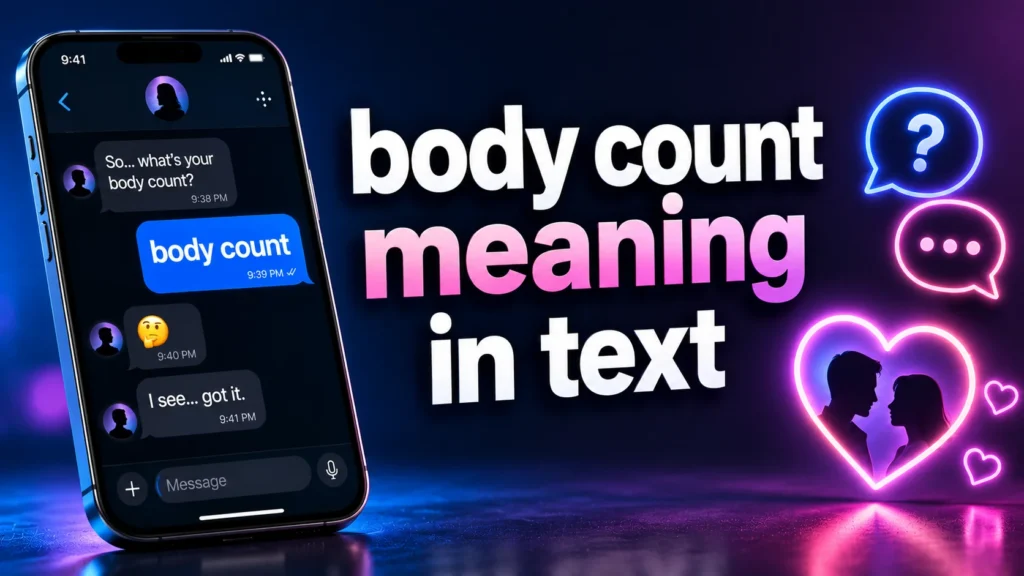
You are chatting with someone new when they suddenly ask, “What’s your body count?” If you only know the traditional meaning of the phrase, that question can sound alarming.
In modern texting and dating slang, the body count meaning in text usually refers to the number of sexual partners a person has had. Merriam-Webster specifically recognizes this slang meaning, while Cambridge Dictionary lists both the sexual-partner meaning and the older meaning involving the number of people who have died.
So, if someone texts:
“What’s your body count?”
They are most likely asking about your sexual history—not asking how many people you have killed.
Still, context matters.
In conversations about war, crime, disasters, horror movies, or violent video games, body count can retain its traditional meaning: the number of deaths.
Because the dating meaning concerns private sexual history, the phrase can also feel intrusive, judgmental, funny, flirtatious, or simply curious depending on who asks and how they ask.
Body Count Meaning in Text – Quick Meaning
Simple Definition
In modern casual texting, body count usually means the number of people someone has had sex with. Cambridge Dictionary recognizes this meaning alongside the older definition involving deaths.
Common interpretations include:
- Number of previous sexual partners
- A question about someone’s dating or sexual history
- Playful curiosity between friends
- A potentially personal dating question
- A topic used in social-media debates
- Number of deaths in a literal crime, war, disaster, or fictional context
For example:
“Be honest, what’s your body count?”
Meaning: “How many sexual partners have you had?”
“Why does everyone care so much about body count?”
Here, the speaker is probably discussing attitudes toward sexual history.
“That horror movie had a crazy body count.”
Here, body count means the number of characters killed, not sexual partners.
Why Context Is Important
The phrase has two substantially different meanings.
If someone says:
“His body count is five.”
inside a dating discussion, it likely concerns sexual partners.
If someone says:
“The movie’s body count reached five before the halfway point,”
the phrase refers to deaths.
Never interpret the expression without looking at the subject of the conversation.
Origin & Background of Body Count
The Original Meaning
The dating meaning is newer than the traditional use.
Merriam-Webster records body count historically as a count of killed enemy soldiers and dates its first known use to 1962. Dictionary.com similarly associates its earlier meaning with the number of soldiers killed during military action.
That explains why people unfamiliar with current slang may find a question such as “What’s your body count?” strange or shocking.
How the Meaning Changed
Over time, body count developed an additional slang meaning referring to the number of sexual partners someone has had.
Merriam-Webster now has a dedicated slang entry defining it this way. Cambridge Dictionary also includes the sexual-history definition in its standard entry.
This is a good example of semantic change: an existing phrase acquires a new meaning because people repeatedly use it in a different social context.
Social Media Impact
Dating discussions on platforms such as TikTok, Instagram, podcasts, comment sections, and private messaging have made the sexual-history meaning highly recognizable.
The phrase can appear in serious conversations about compatibility, but it is also frequently used as a provocative question designed to generate reactions.
One important issue is judgment. Merriam-Webster notes that use of the term can sometimes carry a gendered double standard, particularly when different standards are applied to men and women.
That is why “body count” may feel casual to one person and disrespectful to another.
Real-Life Conversations Using Body Count
WhatsApp Conversation
Person A: Can I ask you something personal?
Person B: Depends what it is 😂
and,
Person A: What’s your body count?
Person B: That’s definitely personal 😭 Why do you want to know?
Moreover,
Person A: Just curious. You don’t have to answer.
Here, body count means previous sexual partners.
The second person also demonstrates an important point: someone can choose not to answer.
Instagram DM
Person A: That video about body count debates is wild.
And,
Person B: People take those numbers way too seriously.
Person A: Exactly. Compatibility is more complicated than one number.
Person B: Facts.
In this conversation, neither person is asking for a number. They are discussing the social meaning attached to sexual history.
TikTok Comments
Creator: “Would someone’s body count matter when you’re dating them?”
Person A: Depends on the person and their values.
and,
Person B: I think honesty matters more.
Person C: Nobody is obligated to share private details online.
Here, “body count” clearly refers to sexual history.
The conversation also shows why the subject can become emotionally charged.
Text Message About a Movie
Person A: Did you finish that horror movie?
Person B: Yeah 😭
And,
Person A: The body count was insane.
Person B: Literally nobody survived.
Here, the phrase has nothing to do with dating.
It means many fictional characters were killed.
Emotional & Psychological Meaning of Body Count
The phrase may look like a simple numerical question, but emotionally it can carry much more weight.
It Can Express Curiosity
Sometimes someone asking:
“What’s your body count?”
is simply curious about a romantic partner’s past.
They may be trying to understand their partner’s experiences, values, or relationship history.
Curiosity alone does not necessarily mean judgment.
It Can Reveal Insecurity
In some relationships, asking about previous partners may come from comparison.
A person might wonder:
“Will I be compared with someone from the past?”
“Am I experienced enough?”
“Does our relationship mean as much?”
Those feelings can turn a simple number into a much bigger emotional issue.
It Can Feel Judgmental
The phrase itself can sound impersonal because it reduces intimate experiences to a numerical “count.”
Merriam-Webster notes that the slang is sometimes associated with gendered judgments about whether a particular number is considered acceptable.
For that reason, some people dislike the expression completely.
A more respectful conversation might focus on present expectations, boundaries, trust, sexual health, and relationship values rather than treating someone’s past as a score.
A Personal-Style Scenario
Imagine you have been talking to someone for several weeks.
One evening they unexpectedly text:
“Okay, serious question… what’s your body count?”
Even if you understand exactly what they mean, you may hesitate.
Perhaps you are comfortable answering. Perhaps you believe the question is too personal at this stage.
Both reactions are reasonable.
The important part is that understanding slang does not create an obligation to disclose private information.
Usage in Different Contexts
Social Media
On social media, “body count” often appears in dating questions, relationship debates, street interviews, memes, and opinion-based videos.
Questions such as:
“Does body count matter?”
can quickly produce disagreement because people have different personal, religious, cultural, and relationship values.
The phrase therefore carries more emotional baggage online than its simple definition suggests.
Friends & Relationships
Among close friends, the phrase may be used casually:
“What’s your body count?”
Some friends may answer openly.
Others may consider the subject private.
In romantic relationships, the question can become more sensitive because jealousy, trust, compatibility, or insecurity may be involved.
Work / Professional Settings
The dating meaning of “body count” is usually inappropriate for professional communication.
Asking a coworker or employee about their number of sexual partners can cross personal boundaries.
The traditional meaning may still appear appropriately in professional contexts involving journalism, history, military affairs, crime reporting, public safety, or film criticism.
Casual vs Serious Tone
Compare:
“Bro really asked everyone their body count at dinner 😭”
This sounds humorous.
Now compare:
“I need to know your body count before this relationship gets serious.”
That is a much more personal conversation.
The phrase is identical, but the emotional implications are very different.
When NOT to Use It
When Someone Has Not Invited Personal Questions
Sexual history is private information.
Avoid casually asking acquaintances, coworkers, strangers, or people you barely know for their body count.
When You Intend to Shame Someone
Using a person’s answer to insult, embarrass, or rank their worth turns a private conversation into judgment.
The slang itself already carries enough social sensitivity that respectful wording matters.
In Formal Communication
Avoid the dating-slang meaning in professional emails, academic writing, workplace conversations, or other formal situations unless you are specifically analyzing slang or social attitudes.
Around Children Without Context
The traditional phrase “body count” can simply refer to deaths.
Its modern dating-slang meaning, however, concerns sexual history and may require an age-appropriate explanation if a child encounters it online.
During Sensitive Conversations
If you genuinely want to understand a partner’s past, asking “What’s your body count?” may sound more judgmental than intended.
A respectful conversation about relationship history, boundaries, health, or expectations may communicate your real concern more clearly.
Common Misunderstandings About Body Count
“Body Count Always Means Sexual Partners”
No.
The traditional meaning relates to deaths.
Cambridge Dictionary explicitly includes both meanings.
“Body Count Literally Means Bodies in Dating Slang”
No.
When used in dating slang, “body” refers figuratively to a sexual partner. The expression is not describing literal dead bodies.
“Someone Has to Answer If Asked”
No.
A question about sexual history is personal.
Someone can answer, decline, redirect the conversation, or discuss the topic differently.
“A Number Tells You Everything About Someone”
A number alone provides very little context about relationships, circumstances, values, health, or a person’s present behavior.
Treating it as a complete measure of character can create misleading assumptions.
“Only Men Use the Term”
No.
The phrase appears broadly in contemporary English-language dating discussions. The attitudes attached to it can differ substantially between individuals and communities.
Body Count Compared With Related Expressions
| Expression | Common Meaning | Tone | Compared With Body Count |
|---|---|---|---|
| Body count | Number of sexual partners / deaths | Casual or sensitive | Main expression |
| Sexual history | Past sexual experiences | Neutral, mature | More respectful/formal |
| Past partners | Previous partners | Neutral | Less objectifying |
| Exes | Former romantic partners | Casual | Not necessarily sexual |
| Dating history | Previous relationships/dates | Neutral | Broader meaning |
| Kill count | Number killed | Violent/gaming context | Similar traditional sense |
| Death toll | Number of deaths | Formal/serious | Clear literal meaning |
| Relationship history | Previous relationships | Mature | Focuses on relationships |
| Experience | Previous romantic/sexual experience | Context-dependent | Less numerical |
| Virgin | Person who has not had sexual intercourse | Personal/sensitive | Related but different |
Key Insight
The biggest source of confusion is context. In dating conversations, “body count” usually means sexual partners; in discussions of death, war, crime, horror, or violent fiction, it usually means the number of people killed.
Variations / Types of Body Count
1. “What’s Your Body Count?”
Meaning: Asking how many sexual partners someone has had.
This is the most recognizable dating-slang form.
2. “What’s His Body Count?”
Meaning: Asking about a man’s number of previous sexual partners.
The tone may be curious, teasing, or judgmental.
3. “What’s Her Body Count?”
Meaning: Asking about a woman’s sexual history.
This wording deserves particular care because the phrase can sometimes be used alongside gendered double standards.
4. “High Body Count”
Meaning: A comparatively large number of previous sexual partners.
What counts as “high” is subjective rather than universal.
5. “Low Body Count”
Meaning: A comparatively small number of previous sexual partners.
Again, there is no universal number defining “low.”
6. “Zero Body Count”
Meaning: In dating slang, usually indicating no previous sexual partners.
Context remains essential because the phrase could mean something completely different in violent or fictional discussions.
7. “Body Count Doesn’t Matter”
Meaning: The speaker believes someone’s number of previous partners should not determine their value or compatibility.
It commonly appears in relationship debates.
8. “Body Count Matters”
Meaning: The speaker considers sexual history relevant when choosing a partner.
This expresses a personal relationship preference rather than a universal rule.
9. “Movie Body Count”
Meaning: Number of characters killed in a movie.
This returns to the older literal meaning of the phrase.
10. “Game Body Count”
Meaning: Number of characters or enemies killed in a video game.
In this setting, interpreting it as sexual slang would usually make no sense.
How to Respond When Someone Asks Your Body Count
Casual Replies
If you are comfortable discussing it:
“Why are you curious? 😂”
“That’s a bold question.”
“I’ll tell you if you tell me why you’re asking.”
These responses keep the conversation open without immediately revealing anything.
Funny Replies
If the tone is clearly playful:
“Nice try 😭”
“That information is classified.”
“My lawyer told me not to answer 😂”
“You really skipped straight to the interview questions.”
Humor can reduce awkwardness without forcing disclosure.
Mature Replies
For a serious dating conversation:
“I’d rather talk about what matters in our relationship now.”
“I’m comfortable discussing my past, but I don’t want it reduced to a number.”
“I think we should talk about expectations and boundaries instead.”
These responses move the discussion toward meaningful relationship issues.
Respectful Replies
If you do not want to answer:
“That’s personal, and I’d rather keep it private.”
“I’m not comfortable sharing that.”
“I’d rather not discuss numbers.”
A respectful boundary does not require a long explanation.
Regional & Cultural Usage
Western Culture
The sexual-slang meaning is recognizable in contemporary English-language dating conversations, while the traditional death-related meaning remains standard dictionary English.
Attitudes toward asking the question vary considerably between individuals.
Asian Culture
English-speaking users across Asian online communities may encounter the slang through international social media, entertainment, dating content, and internet discussions.
Interpretations of sexual history can vary significantly according to family expectations, personal beliefs, religion, age, and social environment.
Middle Eastern Culture
The expression may also be understood among English-speaking social-media users in Middle Eastern communities, particularly younger users exposed to global internet slang.
Because discussions of sexual relationships may be considered highly private in some families and communities, casually asking the question can be especially sensitive.
That should not be generalized to every individual or country.
Global Internet Usage
Online slang crosses cultural boundaries quickly, but social attitudes do not become identical simply because people recognize the same phrase.
Two people can understand exactly what “body count” means and still have completely different opinions about whether it is appropriate to ask.
Gen Z vs Millennials
Younger internet users may encounter the dating-slang meaning frequently through short-form videos, memes, and online relationship discussions.
Other users may still associate “body count” first with its older meaning involving deaths.
Individual exposure to slang is a better predictor than age alone.
Is Body Count Safe for Kids?
The phrase “body count” itself is not automatically inappropriate, because its traditional meaning refers to the number of deaths in a particular event.
However, its modern dating-slang meaning refers to a person’s number of sexual partners.
If a child or younger teenager encounters the phrase online, the explanation should be age-appropriate and straightforward rather than graphic.
It is also useful to explain that personal questions about sexual history involve privacy and boundaries.
FAQs About Body Count Meaning in Text
What does body count mean in texting?
In modern dating slang, body count means the number of sexual partners someone has had. In other contexts, it can mean the number of people killed.
What does “What’s your body count?” mean?
It usually means “How many sexual partners have you had?” It is a personal question, and the person being asked does not have to answer.
What does body count mean from a guy?
If a guy asks about your body count during a dating or personal conversation, he is probably asking about your sexual history. His reason could be curiosity, compatibility concerns, insecurity, teasing, or judgment, so the surrounding conversation matters.
What does body count mean from a girl?
When a girl asks someone’s body count in a dating context, the meaning is generally the same: she is asking about the number of previous sexual partners.
Does body count mean how many people you have dated?
Not exactly.
Dating someone does not necessarily mean having sex with them. In modern slang, body count specifically refers to sexual partners rather than every person someone has dated.
Does body count always have a sexual meaning?
No.
Its older and still-current meaning refers to the number of people killed, especially in contexts involving war, disasters, crime, or violent fiction.
Is asking someone’s body count rude?
It can be.
Some people discuss sexual history openly, while others consider it highly private. The relationship, wording, purpose, and level of trust determine whether the question feels acceptable or intrusive.
Conclusion
The body count meaning in text depends entirely on context, but in modern dating conversations it usually means the number of sexual partners someone has had.
That is very different from the phrase’s older meaning.
In conversations about war, disasters, crime, horror movies, or similar subjects, body count means the number of people who have died. Both meanings remain recognized in contemporary English.
So:
“What’s your body count?”
usually asks about sexual history.
“That horror movie had a huge body count.”
usually refers to deaths.
The words around the phrase tell you which meaning applies.
When the topic involves dating, remember that understanding the slang does not mean you have to answer the question. Sexual history can be personal, and people have different boundaries, values, and comfort levels.
A mature conversation should leave room for privacy and respect rather than turning someone’s past into nothing more than a score.
Once you recognize the context, body count becomes much easier to understand—and much harder to accidentally misinterpret.


