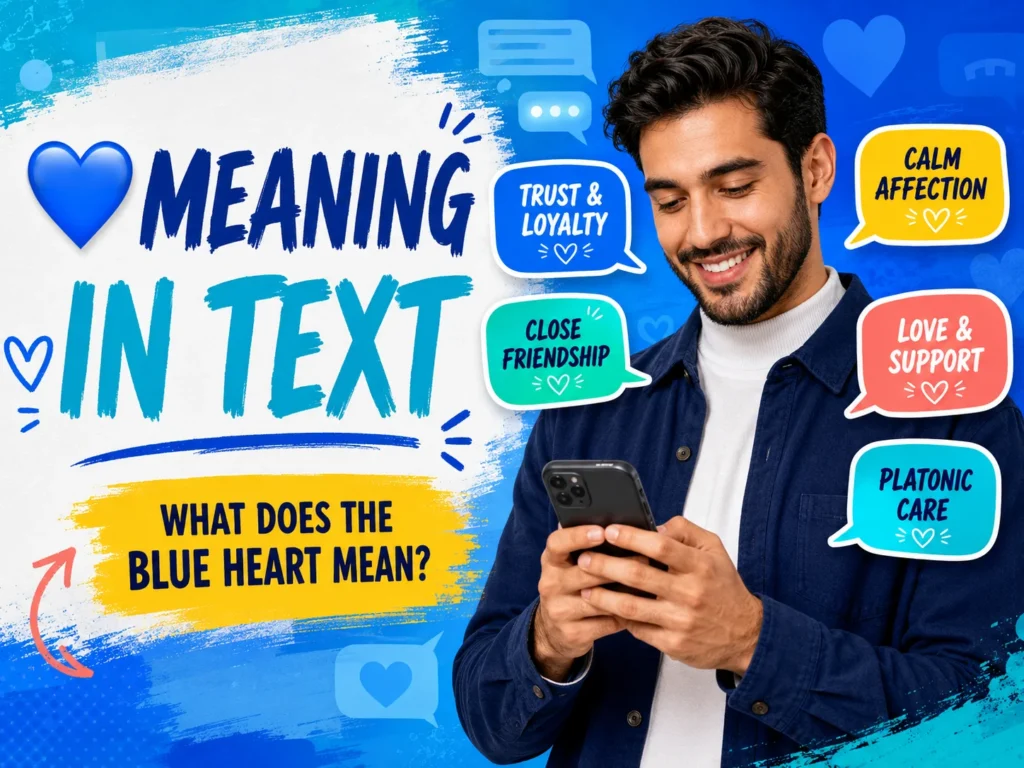
The 💙 meaning in text is usually trust, loyalty, supportive affection, or close friendship. When someone texts it to you, they are often expressing care without the intense romantic tone commonly associated with a red heart.
However, the blue heart emoji does not have one fixed definition. Its meaning depends on your relationship, the accompanying message, the sender’s habits, and the conversation’s emotional tone. It may communicate platonic love, romantic loyalty, encouragement, sympathy, or support for something associated with the colour blue.
What Does 💙 Mean When Someone Texts It to You?
When someone sends you 💙 in a text, it most commonly means:
- “I care about you.”
- “I trust and support you.”
- “You are a good friend.”
- “I’m loyal to you.”
- “I appreciate you.”
- “I’m here for you.”
The blue heart is an emoji symbol, not an acronym or conventional slang abbreviation. Its official Unicode name is Blue Heart, and its code point is U+1F499.
Unlike ❤️, which regularly suggests love, passion, or a strong emotional bond, 💙 often feels calmer and less openly romantic. That does not mean it can never express romance. A partner may use it as a personal relationship symbol, especially when blue is someone’s favourite colour or has a private meaning to the couple.
Context remains more reliable than colour charts found online. There is no universal rule stating that every blue heart means friendship or that it places someone in the “friend zone.”
The Most Common Meanings of the 💙 Emoji
Trust, Loyalty and Dependability
Trust and loyalty are among the most common interpretations of 💙. Blue is culturally associated in many contexts with stability and calmness, so the emoji can make a supportive message feel sincere and dependable.
For example:
“Whatever happens tomorrow, I’m on your side 💙”
Here, the emoji strengthens the promise of support. It does not necessarily suggest romantic attraction.
Platonic Love and Friendship
Friends frequently use 💙 to show affection without making the message sound heavily romantic. It can function like “love you, friend,” “I appreciate you,” or “our friendship matters to me.”
A blue heart from a friend may feel warmer than a thumbs-up but less intimate than a red heart. Nevertheless, individual habits differ. Some friends use red hearts freely, while some romantic partners prefer blue ones.
Emotional Support and Encouragement
The emoji can accompany encouragement when someone is stressed, grieving, recovering, or facing a difficult situation:
“You’re stronger than you think. I’m here if you need me 💙”
In this setting, 💙 communicates emotional presence. The sender may be offering comfort rather than trying to start a romantic conversation.
Calm or Gentle Affection
A blue heart can soften a short message and make it feel peaceful, kind, or reassuring. It is useful when a person wants to express warmth without sounding overly dramatic.
For instance, “Take care of yourself 💙” feels more affectionate than the same sentence without an emoji.
Romantic Love
A romantic partner or crush can use 💙 to mean genuine love. Couples sometimes select a particular heart colour because of a shared memory, favourite colour, sports team, nickname, or inside joke.
A romantic interpretation becomes more likely when 💙 appears with flirting, pet names, intimate compliments, or established expressions of love. One isolated emoji cannot prove attraction, but the surrounding pattern may reveal it.
Appreciation for Something Blue
People also use 💙 to show support for a team, school, organisation, character, country, campaign, or fandom represented by blue. In that case, the emoji may refer more to identity or colour association than personal affection.
Examples include:
- Celebrating a sports team with blue uniforms
- Matching a school or organisation’s colours
- Showing enthusiasm for blue clothing or artwork
- Supporting a fandom that uses blue symbolically
Sympathy, Remembrance or Grief
The blue heart sometimes appears in condolences or remembrance messages. It can offer quiet compassion, particularly when blue had personal relevance to the person being remembered.
This meaning must be read from the message itself. A blue heart sent after “I’m so sorry for your loss” clearly carries a different meaning from one sent after a playful compliment.
💙 Meaning on Different Messaging Platforms
SMS, iMessage and WhatsApp
In SMS, iMessage and WhatsApp conversations, 💙 usually expresses supportive affection, friendship, trust or loyalty. It can appear after a full message or serve as a short response when words feel unnecessary.
Someone replying with only 💙 may mean:
- “I appreciate that.”
- “Sending love.”
- “I’m with you.”
- “That means a lot.”
- “I care too.”
Because these services often contain private one-to-one conversations, your relationship with the sender matters more than the platform.
Instagram, Snapchat and Discord DMs
In private Instagram or Snapchat messages, 💙 can be friendly, flirty or aesthetically chosen. Younger users may select a heart colour to match a profile theme, outfit, photo or ongoing visual style.
On Discord, friends and community members may use it to express appreciation, encouragement or affiliation with a group. In all three settings, repeated affectionate messages carry more interpretive weight than one isolated emoji.
TikTok and X
The blue heart also appears in TikTok comments and X posts, although these are not always private texts. In public spaces, it commonly signals appreciation for a creator, support for a cause, team or fandom, or enthusiasm for something associated with blue.
Public use is usually broader and less personal than a heart sent in a private conversation.
Does Its Appearance Change Across Platforms?
Apple, Google, Samsung and other platforms render 💙 with slightly different shading, gloss and shape. The core symbol remains the same, so those visual differences do not normally alter its meaning.
Users may type one heart, repeat it as 💙💙💙, or combine it with other emojis. Repetition usually increases emphasis rather than creating a completely new definition.
Tone Variations of 💙 in Text Messages
Funny
A blue heart can make teasing feel affectionate rather than harsh.
A: You ate the snacks I was saving, didn’t you?
B: I can explain.
A: You have five seconds.
B: They sacrificed themselves for a good cause 💙
The heart suggests playful confidence, not a serious emotional declaration.
Sarcastic
In a sarcastic exchange, 💙 can add exaggerated sweetness.
A: Thanks for replying three business days later.
B: I wanted to build suspense.
A: How thoughtful of you.
B: Always here for you 💙
The surrounding words make the sarcasm clear. The emoji alone would not necessarily carry that tone.
Playful or Flirty
A crush may use 💙 as a low-pressure form of affection.
A: Are you always this charming?
B: Only when I’m talking to you.
A: That answer sounded rehearsed.
B: Still worked though 💙
Here, the emoji reinforces the flirting because the conversation is already suggestive.
Serious and Supportive
In a serious exchange, 💙 can express reassurance.
A: I’m really nervous about tomorrow.
B: That makes sense, but you’ve prepared properly.
A: I hope it’s enough.
B: I believe in you, and I’m only a call away 💙
The emoji communicates emotional support rather than flirtation.
Realistic Examples of 💙 in Text Conversations
Between Close Friends
A: Thank you for listening last night.
B: Of course. You never have to handle everything alone.
A: I really appreciate you.
B: Always here 💙
Meaning: Loyal friendship and support.
From a Romantic Partner
A: Made it home safely.
B: Good. I was waiting to hear from you.
A: You can stop worrying now.
B: Impossible—I love you 💙
Meaning: Romantic care and personal affection.
From a Crush
A: I had a really good time today.
B: Me too. We should do it again.
A: Is Friday too soon?
B: Friday sounds perfect 💙
Meaning: Likely gentle flirting, especially if attraction is already present.
From a Coworker
A: I’ve sent you the notes from the meeting.
B: You’ve saved me so much time.
A: Happy to help.
B: Thank you! 💙
Meaning: Friendly gratitude, not necessarily romance.
From a Parent
A: My exam starts in an hour.
B: Stay calm and read every question carefully.
A: I’ll try.
B: You’ll do brilliantly 💙
Meaning: Parental encouragement and love.
From a Sibling
A: Can you collect my parcel on your way home?
B: You owe me.
A: I’ll buy you coffee tomorrow.
B: Deal 💙
Meaning: Casual family affection or playful appreciation.
After an Apology
A: I’m sorry I spoke to you like that.
B: I was hurt, but I appreciate the apology.
A: I’ll handle it better next time.
B: Let’s move forward 💙
Meaning: Reconciliation, forgiveness and calm affection.
During a Difficult Time
A: Today has been exhausting.
B: Do you want advice or just someone to listen?
A: Honestly, just listen.
B: I’m here 💙
Meaning: Emotional safety and support.
From a New Friend
A: Thanks for making me feel welcome today.
B: I’m glad you came with us.
A: I was nervous at first.
B: You fit right in 💙
Meaning: Warm friendship, not clear evidence of romantic interest.
From a Stranger Online
A: Your post helped me feel less alone.
B: I’m glad it reached someone who needed it.
A: Thank you for sharing it.
B: Take care of yourself 💙
Meaning: Compassion and supportive goodwill.
In a Group Chat
A: I finally passed my driving test!
B: We knew you could do it.
C: Celebration this weekend?
D: Proud of you 💙
Meaning: Group encouragement and celebration.
After a Compliment
A: Blue really suits you.
B: That’s my favourite colour.
A: I think it might be mine now too.
B: Smooth 💙
Meaning: Playful affection that may be flirtatious.
Is 💙 Romantic or Friendly?
The blue heart can be either romantic or friendly. However,It is commonly interpreted as platonic because it feels less passionate than ❤️, but that distinction is only a social tendency—not a fixed emoji rule.
It is more likely to be romantic when the person:
- Regularly flirts with you
- Sends intimate or affectionate messages
- Uses pet names
- Talks about dating or seeing you
- Sends 💙 after saying “I love you” or “I miss you”
It is more likely to be friendly when it follows thanks, encouragement, congratulations or casual conversation. Consider the sender’s behaviour across multiple exchanges instead of treating one emoji as proof of their feelings.
Grammar and Language Role of 💙
Part of Speech
An emoji has no fixed traditional part of speech. Depending on context, 💙 can function like a noun representing love, an emotional marker, a reaction, or a substitute for an entire supportive statement.
Position in a Message
The blue heart most naturally appears:
- At the end: “Proud of you 💙”
- As a complete reply: “💙”
- Beside another emoji: “You’ve got this 💙🙌”
- Repeated for emphasis: “Thank you 💙💙”
It is less commonly inserted into the middle of an ordinary sentence unless used decoratively.
Can It Replace a Full Sentence?
Yes. A standalone 💙 may communicate “love this,” “sending support,” “thank you,” or “I care.” However, because it relies heavily on context, it may be unclear during serious discussions.
Capitalisation and Variants
Capitalisation does not apply to emojis. One blue heart generally feels gentle, while several blue hearts can express stronger enthusiasm or affection.
The darker 💙 and newer light-blue heart 🩵 are different Unicode characters. People may use them similarly, but their colour and aesthetic are not identical.
Formal and Informal Use
💙 belongs mainly to informal digital communication. It works naturally with friends, relatives, partners and familiar colleagues. In formal workplace, academic, legal or customer-service messages, words are usually safer and clearer.
How to Reply to 💙 in a Text
Funny Reply
“A premium blue heart? I must be important 😌”
Serious Reply
“Thank you. Your support genuinely means a lot to me 💙”
Flirty Reply
“Is that a friendly heart, or should I be reading into it? 😉”
Use this only when flirting is appropriate and the other person appears comfortable.
Neutral or Unbothered Reply
“Thank you!”
Matching Reply
“💙”
Mirroring the emoji is an easy response when you understand and welcome the sentiment.
💙 Compared With Similar Heart Emojis
| Term | Meaning | Usage Context | Tone | Popularity | Confusion Risk |
|---|---|---|---|---|---|
| 💙 | Trust, loyalty, support or calm affection | Friends, partners, encouragement | Warm and steady | High | High because it may be friendly or romantic |
| ❤️ | Love, passion or strong affection | Partners, family, close friends | Intense and affectionate | Very high | Medium |
| 🩵 | Gentle affection, calmness or blue-themed appreciation | Friends, aesthetics, supportive messages | Soft and light | Growing | High because it resembles 💙 |
| 💜 | Affection, admiration or purple-related support | Friends, fandoms, partners | Warm or expressive | High | Medium |
| 🤍 | Pure affection, sympathy or remembrance | Support, condolences, minimalist aesthetics | Gentle and sincere | High | Medium |
| 💔 | Heartbreak, sadness or emotional pain | Breakups, disappointment, grief | Painful | Very high | Low |
| 👍 | Approval or acknowledgement rather than affection | Casual and workplace messages | Neutral | Very high | Medium because it may seem emotionally distant |
Who Uses the Blue Heart Emoji?
Age Groups
Teenagers and young adults frequently use coloured hearts to control tone, match an aesthetic or distinguish between types of affection. Older adults also use 💙, but they may be less likely to assign a specific social meaning to its colour.
These are broad tendencies, not universal rules. Emoji interpretation depends more on personal texting habits than age alone.
Gen Z Versus Millennials
Gen Z users may switch among several heart colours based on mood, visual style, friendship dynamics or community associations. They may also use a heart ironically or as part of understated flirting.
Millennials commonly use 💙 for direct affection, support or a colour-related association. Both groups use it in friendships and romantic relationships, so it cannot reliably identify the sender’s intention by generation.
Regional Usage
💙 is understood globally as a heart symbol, but no single romantic-versus-platonic rule applies across the United States, United Kingdom or other regions. Local groups, schools, teams and online communities can give it additional context.
Claims such as “a blue heart always means friendship in one country” are too absolute. Personal and community conventions matter.
Origin and Internet Culture
Blue Heart was included in Unicode 6.0 in 2010 and later formed part of the standardised emoji set used across modern devices. Unicode’s background documentation shows that coloured heart symbols were among emoji inherited from earlier Japanese mobile-phone systems. Unicode’s emoji documentation explains how hundreds of Japanese carrier emoji were incorporated for cross-platform compatibility.
Therefore, 💙 was not invented by TikTok, Snapchat or a recent meme. Its history comes from early mobile emoji culture and the effort to make symbols display consistently across devices.
As messaging platforms expanded, users informally developed associations for different heart colours. However, these associations were never established as strict definitions. Emojipedia similarly notes that coloured hearts can express appreciation for people, objects, groups or ideas connected to that colour, while brands may use blue as a relatively neutral heart. Emojipedia’s Blue Heart guide supports this broader, context-dependent interpretation.
Internet culture has encouraged users to treat heart colours as a flexible emotional palette. That creativity makes 💙 useful, but it also explains why one chart cannot decode every sender’s intention.
Is 💙 Rude, Offensive or Inappropriate?
The blue heart is not profanity, explicit slang or inherently offensive. It is generally one of the safest heart emojis because it can communicate support without automatically suggesting passion.
Still, appropriateness depends on the recipient:
- A friend or relative will usually understand it positively.
- A partner may interpret it as affectionate.
- A coworker may find it friendly, though formal boundaries still matter.
- A boss, teacher or unfamiliar client may prefer a direct verbal response.
- Someone grieving may welcome it, but sincere words should accompany it.
Avoid relying on a single emoji when apologising, discussing conflict, delivering bad news or responding to a serious disclosure. In those situations, words demonstrate greater care.
Real-World Observation
In actual text conversations, 💙 often works as a tone regulator. It makes brief messages such as “okay,” “take care,” or “thank you” feel warmer without introducing the intensity of a red heart. Its durability comes from this flexibility: friends can use it casually, couples can assign it private significance, and communities can connect it to a shared colour. That versatility is also why interpreting it requires context rather than a rigid definition.
Frequently Asked Questions
Is It Rude to Reply With Just 💙 in a Text?
No, replying with only 💙 is normally warm and positive. It can acknowledge affection, support or a thoughtful message without repeating the sender’s words. During a serious or vulnerable conversation, however, adding a sentence may feel more caring and prevent misunderstanding.
Does 💙 Mean Someone Has Put Me in the Friend Zone?
Not necessarily. Blue is often associated with friendship, but the emoji does not officially label a relationship as platonic. Look at whether the person flirts, initiates conversations, makes plans and expresses romantic interest elsewhere.
What Does 💙 Mean From a Girl?
From a girl, 💙 may express friendship, trust, appreciation, comfort or romantic affection. Her gender does not give the emoji a special fixed definition. The conversation and your existing relationship are the best evidence.
What Does 💙 Mean From a Guy?
From a guy, it can mean supportive friendship, loyalty, sincere appreciation or romantic interest. Some people choose blue simply because it is their favourite colour or feels more natural than red. Do not assume either attraction or rejection from the emoji alone.
What Is the Difference Between Texting 💙 and Saying It Out Loud?
Spoken language provides voice, pacing and facial expression, while a text removes those cues. The emoji compensates by adding warmth or affection to written words. Because it remains indirect, it can feel gentler—but also more ambiguous—than saying “I love you” or “I’m here for you.”
Does 💙 Mean the Same Thing in a Group Chat and a One-to-One Text?
Not always. In a group chat, it often represents encouragement, team spirit or general appreciation. In a private conversation, it may feel more personal, particularly when paired with affectionate language.
Why Did My Crush Send Me a Blue Heart Instead of a Red Heart?
Your crush may be showing gentle affection, testing a flirtatious tone or simply using a preferred colour. A blue heart is not automatic evidence that they want only friendship. Consider the entire conversation and their consistent behaviour before reaching a conclusion.
What Is the Difference Between 💙 and 🩵?
Both can express calm affection, friendship or support. 💙 has a darker blue appearance and has been available since Unicode 6.0, while 🩵 is a separate light-blue heart introduced much later. Most differences come from aesthetics and personal preference rather than a universally recognised emotional code.
Conclusion
The 💙 meaning in text is usually trust, loyalty, friendship, encouragement or calm affection. It can also be romantic, especially when sent by a partner or combined with flirting and intimate language.
Usage Tips
- Read the full message, not only the emoji.
- Consider your relationship with the sender.
- Use 💙 to make supportive messages feel warmer.
- Add words when the subject is serious or emotionally sensitive.
Common Mistakes
- Assuming 💙 always means the friend zone
- Treating heart-colour charts as universal rules
- Believing several hearts create an entirely new meaning
- Ignoring the sender’s normal emoji habits
Use 💙 in casual texts when you want to express care, trust, encouragement or relaxed affection. Avoid relying on it alone in formal communication, major apologies, emotional conflicts or situations where your intention must be completely clear.


