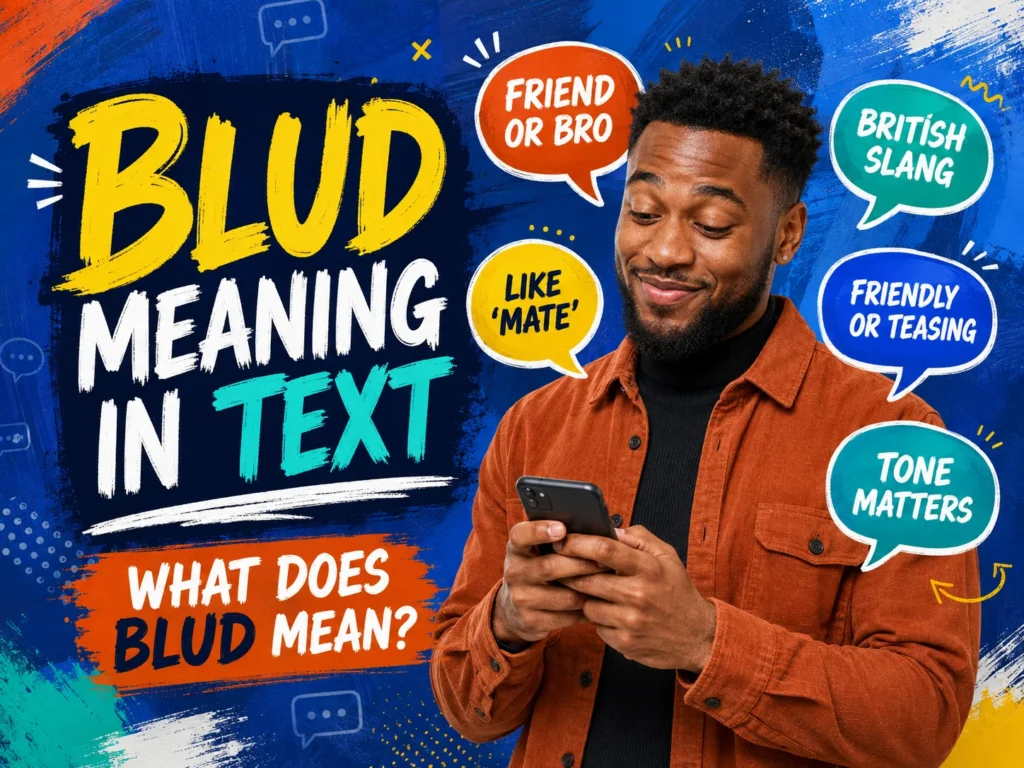
Blud meaning in text is usually “bro,” “friend,” “mate,” or “guy.” When someone texts you “blud,” they may be addressing you casually, teasing you, or reacting to something embarrassing you said.
For example, “Blud really thought that would work” means, “This guy genuinely thought that would work.” The tone is normally humorous or mocking rather than openly aggressive.
The expression began in British urban slang and is connected to the word “blood.” It later became globally recognizable through football memes, gaming communities, TikTok videos, and reaction posts.
Its exact meaning depends on context. From a close friend, “What are you doing, blud?” can sound affectionate. From a stranger during an argument, the same word may feel condescending or confrontational.
Blud Meaning in Text – Quick Meaning
“Blud” is an informal slang word used to mean brother, close friend, mate, or person. Online, it can also mean “this guy” when someone is joking about another person’s behaviour.
The most common meanings are:
- Bro or brother
- Friend or close mate
- This guy or this person
- A humorous way to address someone
- A mildly mocking label
- A confrontational form of address in some situations
“Blud” is a slang word rather than a modern texting acronym. It does not have separate words represented by each letter.
“You good, blud?”
Meaning: “Are you okay, bro?”
“Blud thinks he’s the main character.”
However, Meaning: “This guy thinks he is the centre of attention.”
“Where have you been, blud?”
Meaning: “Where have you been, mate?”
The term is usually written in lowercase, although “BLUD” may be used for emphasis. Capitalization does not change its basic definition.
Origin and Background of “Blud”
The connection between “blud” and “blood”
“Blud” is a phonetic spelling of “blood.” Calling someone “blood” can suggest a bond as strong as family, even when the two people are not biologically related.
In this sense, the word developed in a similar way to “brother,” “bro,” or “fam.” It communicates closeness, loyalty, and shared identity.
The expression became especially associated with British urban speech, including multicultural London slang. Caribbean linguistic and cultural influences also helped shape how terms connected to family, friendship, and community were used in Britain.
It would be too simple to treat “blud” as belonging to only one group. Slang moves through music, neighbourhoods, schools, football communities, and friendship circles before reaching mainstream internet culture.
Music and street culture
British grime, garage, drill, and rap helped make “blud” more familiar outside the communities where it was already spoken. Listeners heard artists use it naturally when addressing friends, rivals, or other people.
The tone could change from warm to confrontational within a single conversation. This flexibility remains part of its modern meaning.
Social media evolution
TikTok, YouTube, Instagram, and X introduced “blud” to international audiences. Many users now understand it through memes rather than traditional British conversation.
The popular meme pattern “blud thinks…” transformed the word into a humorous alternative to “this guy.”
For example:
“Blud thinks he’s on the team.”
The speaker is joking that someone is behaving as if they belong to a group when they do not.
As a result, “blud” is no longer used only as a direct nickname for a friend. It can also refer to a stranger, fictional character, animal, or even an object behaving in a funny way.
Real-Life Conversations Using “Blud”
WhatsApp conversation between friends
Adam: I told everyone I could cook, but I burned the pasta.
Hamza: Blud, how do you burn pasta? 😭
Adam: I forgot it was on the stove.
Here, “blud” means “bro.” Hamza is teasing Adam, but the crying emoji makes the exchange feel playful rather than hostile.
Instagram DM conversation
Ryan: Did you see my new profile picture?
Jay: Yeah, blud thinks he’s a fashion model now.
Ryan: Let me enjoy my moment 😂
Jay uses the popular “blud thinks…” format to make fun of Ryan’s confidence. Their friendly responses suggest that both understand the joke.
TikTok comment exchange
Commenter A: Blud celebrated before the ball even went in.
Commenter B: The confidence disappeared so quickly.
In this example, “blud” means “this guy.” The commenter may not know the person in the video personally.
Text-message argument
Person A: Why are you talking about me?
Person B: Calm down, blud. It wasn’t that serious.
Person A: Don’t speak to me like that.
Here, “blud” sounds dismissive because the conversation is already tense. The term itself is not extremely offensive, but the sender’s tone makes it disrespectful.
Emotional and Psychological Meaning
“Blud” often creates a feeling of informal male friendship. Like “bro,” it can reduce emotional distance and make a conversation feel relaxed.
A person might say “You all right, blud?” instead of using someone’s name because the slang sounds warmer within their friendship group. It communicates, “You are one of us.”
The term can also create humour through exaggerated familiarity. Online commenters call complete strangers “blud” as if they are discussing a friend whose behaviour everyone recognizes.
Mockery is another important layer. The phrase “blud thinks…” places the subject outside the speaker’s circle and invites others to laugh at them.
Imagine a student walking confidently toward the teachers’ parking area before realizing he is in the wrong place. His friend records the moment and captions it, “Blud thinks he owns the school.” The caption is not literally calling him a blood relative. It playfully highlights the difference between his confidence and reality.
In an argument, however, “blud” can express dominance or impatience. “Listen, blud” may sound like a warning rather than a sign of friendship.
Usage in Different Contexts
SMS, iMessage, and WhatsApp
In private texts, “blud” commonly works like “bro” or “mate.”
Examples include:
- “Thanks, blud.”
- “Where are you?”
- “You coming tonight, blud?”
- “That was funny, blud.”
- “I’ve got you, blud.”
The relationship between the senders usually determines whether it feels natural.
Instagram and Snapchat
On Instagram and Snapchat, “blud” may appear in direct messages, captions, or replies to stories.
Someone might respond to an unusually confident selfie with:
“Blud thinks he’s famous.”
The message is teasing, although it could feel insulting if the people do not know each other well.
TikTok and YouTube
On video platforms, “blud” is strongly connected with reaction humour. Commenters use it to describe someone doing something awkward, ambitious, confusing, or unexpectedly confident.
Common patterns include:
- “Blud thought we wouldn’t notice.”
- “Blud is fighting for his life.”
- “Blud forgot the camera was recording.”
- “Blud thinks he’s part of the group.”
- “What is blud doing?”
In these examples, “blud” generally means “this person” or “this guy.”
Football communities
British football culture helped spread the expression internationally. Fans use “blud” when reacting to players, referees, managers, and other supporters.
For example:
“Blud missed an open goal and blamed the pitch.”
The comment humorously criticizes a player’s mistake.
Friends and relationships
Between friends, “blud” can show affection and loyalty. In romantic communication, it may make the conversation sound deliberately unromantic.
If someone you like suddenly calls you “blud,” they may simply speak that way with everyone. Still, it can sometimes suggest they view you more like a friend than a romantic interest.
One word cannot confirm whether you have been “friend-zoned.” Look at the complete pattern of communication.
Professional settings
“Blud” is unsuitable for formal emails, job interviews, academic writing, customer communication, or conversations with senior colleagues.
Use “friend,” “colleague,” the person’s name, or another professional form of address instead.
When Not to Use “Blud”
Avoid “blud” when the relationship or situation requires respect and clarity. Not everyone recognizes the term, and some people may hear it as forced, dismissive, or confrontational.
Do not use it:
- In professional emails
- During a job interview
- When addressing a teacher or manager
- In formal academic work
- During a serious disagreement
- With someone who has asked you to stop
- When copying a cultural style you do not understand
- In situations involving grief or emotional distress
- When speaking to a customer or client
Cultural awareness matters because “blud” has roots beyond temporary internet humour. Repeating it excessively to imitate a British urban accent can sound unnatural or mocking.
It is also better to avoid saying “Calm down, blud” during an argument. “Calm down” already risks sounding dismissive, while “blud” may make the sentence more confrontational.
If you are uncertain, choose a familiar alternative such as “mate,” “bro,” “friend,” or the person’s name.
Common Misunderstandings About “Blud”
“Blud” is not usually a spelling mistake
Someone typing “blud” normally does not mean they have accidentally misspelled “blood.” The unusual spelling reflects how the slang is pronounced.
It does not always mean a close friend
Historically, the term can communicate closeness, but internet users now apply it to strangers. In “Blud thinks he can fly,” the speaker may be discussing someone they have never met.
It is not automatically an insult
“Thanks, blud” can be friendly. “Who do you think you are, blud?” sounds aggressive. Tone and context create the difference.
It does not literally mean a relative
“Blud” may suggest a brother-like bond, but it does not usually indicate that two people share the same family or bloodline.
The “blud thinks” meme is normally sarcastic
When someone writes “Blud thinks he’s famous,” they usually believe the person is acting more important or confident than the situation justifies.
It is not identical to “blood”
“Blood” has literal meanings involving the human body and family relationships. “Blud” usually signals the slang meaning, especially in texts and comments.
It is not always romantic rejection
Being called “blud” does not automatically mean someone has rejected you romantically. Some people use “blud,” “bro,” and “mate” with nearly everyone.
“Blud” Compared With Similar Slang
| Expression | Common meaning | Usual tone | Difference from “blud” |
|---|---|---|---|
| Bro | Brother or friend | Friendly and casual | More universally recognized |
| Bruh | Bro; also a reaction to nonsense | Casual or frustrated | Often expresses disbelief |
| Mate | Friend or casual form of address | Friendly or confrontational | Common in British and Australian English |
| Fam | Close friend or trusted group | Warm and loyal | Refers to family-like closeness |
| Blood | Relative or extremely close friend | Loyal and serious | Standard spelling with literal meanings |
| Dawg | Close friend or guy | Casual and playful | Strongly influenced by American slang |
| G | Friend, respected person, or gangster | Friendly or admiring | Often communicates respect |
| Homie | Friend from one’s neighbourhood or group | Friendly | More associated with American slang |
| My guy | Friend or a person being addressed | Friendly or sarcastic | Meaning changes sharply with tone |
| Stranger | An unknown person | Neutral | Opposite of the original friendship sense |
| Opp | Rival or enemy | Hostile | Opposite of a trusted “blud” |
| This guy | A person being discussed | Neutral or mocking | Closest standard-English meme equivalent |
Key Insight
“Blud” overlaps with “bro” when addressing a friend, but it resembles “this guy” when used in memes. The sentence structure often reveals which meaning applies.
Variations and Types of “Blud”
1. Blud
The standard form means “bro,” “mate,” or “this guy.” It can sound friendly, sarcastic, or confrontational.
2. BLUD
The uppercase version adds emotional emphasis. It may show shock, frustration, or exaggerated humour.
Example: “BLUD, WHAT ARE YOU DOING?”
3. My blud
“My blud” communicates friendship, loyalty, or affection. It is similar to saying “my brother” or “my close friend.”
4. What is blud doing?
This popular reaction means, “What is this person doing?” It is used when someone behaves awkwardly, strangely, or unexpectedly.
5. Blud thinks
“Blud thinks…” introduces a sarcastic observation about someone’s confidence or mistaken belief.
Example: “Blud thinks he won the argument.”
6. Bro thinks he’s blud
This ironic meme variation intentionally plays with internet language. Its confusing structure is part of the joke.
7. Lil blud
“Lil blud” means “little bro” or “young guy.” It may be affectionate, patronizing, or disrespectful depending on the relationship.
8. Big blud
“Big blud” can refer to an older, larger, or more respected friend. It may also be used humorously.
9. Blud really thought
This phrase highlights someone’s failed assumption.
Example: “Blud really thought nobody would notice.”
10. This blud
“This blud” means “this person” or “this guy.” It is more likely to sound mocking than affectionate.
11. Thanks, blud
This is a friendly expression of appreciation between people who are comfortable with the slang.
12. Calm down, blud
This means “calm down, bro,” but it may sound dismissive during a disagreement.
How to Respond When Someone Says “Blud”
Before replying, decide whether the sender sounds friendly, funny, sarcastic, or aggressive.
Casual replies
- “What’s good, blud?”
- “I’m good, bro.”
- “What happened?”
- “Yeah, mate?”
- “I hear you.”
Funny replies
- “Blud discovered British slang.”
- “What am I doing now? 😭”
- “Blud really called me blud.”
- “Allow me to explain myself.”
- “The meme vocabulary is getting serious.”
Friendly replies
- “Always here for you, blud.”
- “Appreciate you, mate.”
- “You already know.”
- “My guy!”
- “Thanks, bro.”
Mature replies
- “Are you joking or being serious?”
- “What exactly do you mean?”
- “Let’s keep the conversation respectful.”
- “I’d rather you use my name.”
- “We can disagree without talking down to each other.”
Replies to mockery
- “At least I tried.”
- “You understood the idea, though.”
- “Laugh now—I’ll get it right next time.”
- “Good one. Now answer the question.”
- “If you have a point, say it directly.”
You do not have to copy the slang back. A simple “What?” or “What do you mean?” is completely natural.
Regional and Cultural Usage
United Kingdom
“Blud” is most strongly associated with British urban slang, particularly London and other culturally diverse cities. It may function naturally as a form of address between friends.
British speakers are also likely to recognize when its delivery sounds warm, challenging, or disrespectful.
United States and Canada
North American users often encounter “blud” through memes, British creators, football content, and TikTok comments. They may use it mainly in the phrase “blud thinks…” rather than in everyday speech.
Australia and New Zealand
Users may understand “blud” online, although “mate,” “bro,” and “bruh” are usually more natural in local conversation.
Asian communities
Across South Asia and other Asian regions, younger English speakers often learn “blud” through football pages, gaming, rap music, YouTube, and TikTok.
The meme meaning—“this guy”—may be more familiar than its original friendship sense.
Middle Eastern communities
Young social media users may recognize the term through English-language gaming, football, and entertainment content. It remains highly informal and may not be understood by older generations.
Global internet culture
Online, “blud” has become a reusable character label. People apply it to humans, animals, animated characters, robots, and objects.
A video of a cat trying to open a cupboard might receive the comment:
“Blud thinks he pays rent.”
The cat is humorously treated like an overly confident person.
Gen Z versus Millennials
Many Gen Z users recognize “blud” as meme language and use it for comic reactions. Millennials familiar with British grime or urban culture may connect it more strongly with “friend” or “brother.”
The difference shows how online culture can give an established slang term a second, more international life.
Is “Blud” Safe for Kids?
“Blud” is generally not a swear word or sexually explicit expression. In friendly contexts, it simply means “bro,” “friend,” or “this person.”
However, children should understand that it can sound mocking or confrontational. Using “blud” to gang up on someone in comments may contribute to online bullying, even though the word itself is relatively mild.
Parents and teachers can explain it simply:
“Blud is informal slang for bro or guy, but its tone can be friendly or disrespectful.”
Children should avoid using it in formal schoolwork, when addressing teachers, or when making fun of someone online.
Frequently Asked Questions
What does “blud” mean when someone texts you?
When someone texts you “blud,” they usually mean “bro,” “friend,” or “mate.” They may be speaking warmly, teasing you, or addressing you during a disagreement.
What does “blud” mean on TikTok?
On TikTok, “blud” often means “this guy” or “this person.” It frequently appears in humorous comments such as “Blud thinks he’s famous.”
Is “blud” a bad word?
No, “blud” is not normally considered a swear word. Still, it can sound disrespectful when used mockingly, aggressively, or toward someone who dislikes the term.
What does “blud thinks he’s…” mean?
It means the speaker believes someone is acting as if they have a role, ability, or status they do not really possess. The phrase is usually sarcastic.
Does “blud” mean brother?
Yes. “Blud” can mean a brother-like friend, similar to “bro.” It does not usually refer to a biological brother.
What does “blud” mean from a girl?
From a girl, “blud” usually means “bro,” “mate,” or “this guy.” It may suggest casual friendliness, but one word alone cannot confirm romantic interest or rejection.
Why do people say “blud” instead of “bro”?
Some people use it naturally because of their cultural or regional speech. Others choose it for humour because “blud” has become popular in memes and reaction comments.
Conclusion
Blud meaning in text is usually “bro,” “friend,” “mate,” or “this guy.” It began as a friendship-based form connected to “blood” and later gained a humorous global identity through memes.
When someone says, “Thanks, blud,” the tone is probably friendly. When they comment, “Blud thinks he’s a celebrity,” they are teasing or mocking someone. During an argument, the term can become confrontational.
Pay attention to the relationship, sentence, emojis, and emotional situation. Understanding these clues will help you recognize whether “blud” expresses friendship, internet humour, or disrespect—and choose a reply that matches the moment.


