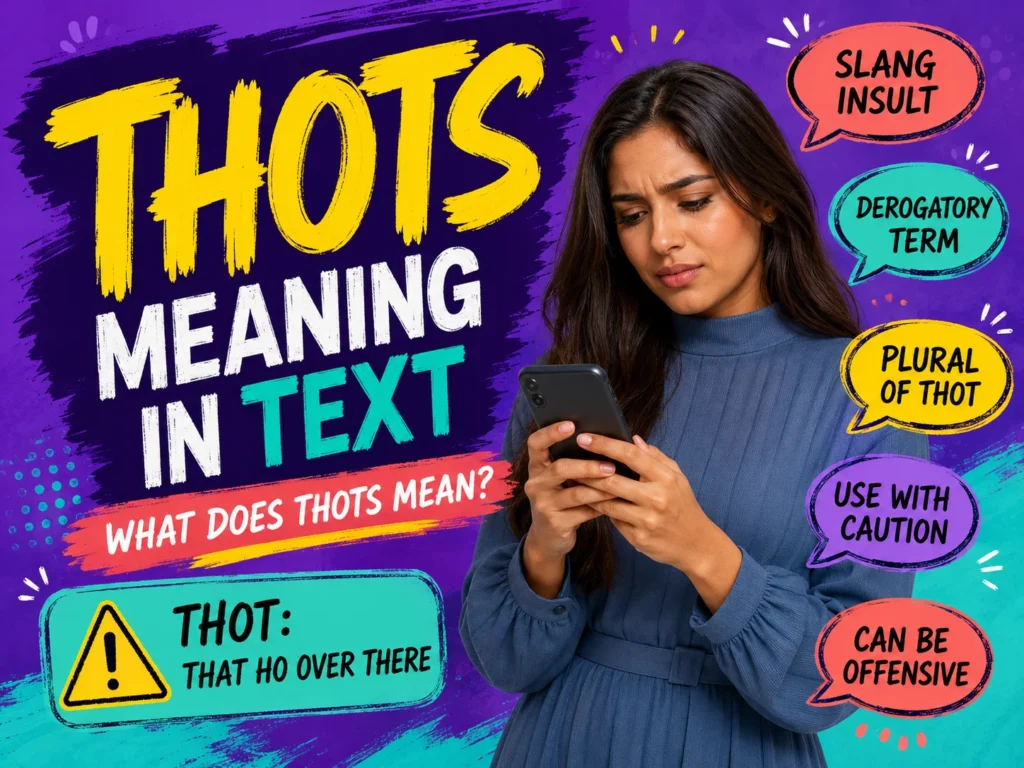
Thots meaning in text usually refers to women whom someone considers sexually promiscuous, attention-seeking, or involved with multiple romantic partners. It is the plural form of “thot,” a derogatory slang term commonly expanded as “That Hoe Over There.”
People often see “thots” in group chats, song lyrics, memes, gaming conversations, Instagram comments, and TikTok videos. The word may sometimes be used jokingly among close friends, but its underlying meaning remains insulting and sexually judgmental.
Understanding the term matters because tone changes everything. A friend may use it as playful banter, while a stranger may use the same word to shame, disrespect, or harass someone.
This guide explains what “thots” means when someone texts it to you, how it developed, where it appears, and how you can respond confidently.
Thots Meaning in Text – Quick Meaning
“Thots” is the plural form of “thot.” In texting slang, it generally means women who are perceived as promiscuous, flirtatious, or constantly seeking romantic or sexual attention.
The basic meanings include:
- Women being criticized for their dating or sexual behaviour
- Girls someone views as attention-seeking
- A joking label for flirtatious friends
- An insult used to shame women
- A meme-based reference influenced by rap and internet culture
Although “THOT” is often written as an acronym for “That Hoe Over There,” most people type it in lowercase as an ordinary slang word: “thot” or “thots.”
“He stopped talking to those thots.”
In this example, the sender is disrespectfully describing several women.
“We’re going out tonight, thots!”
Here, close friends may be reclaiming the word playfully. It is still risky outside a trusted friendship.
“The comments are full of people calling her a thot.”
This example describes online sexual shaming rather than friendly humour.
The safest interpretation depends on who sent it, whom they were describing, and whether the conversation felt humorous, hostile, jealous, or judgmental.
Origin and Background of “Thots”
Where did the term come from?
“Thot” became widely recognized through American hip-hop and internet culture during the early 2010s. It is commonly interpreted as an abbreviation of “That Hoe Over There,” although it now functions as an independent slang word.
Chicago drill and rap culture helped popularize it through lyrics and online conversations. The term later moved beyond music into memes, reaction videos, gaming communities, and everyday social media language.
It is difficult to credit one person with inventing the expression. Slang often develops within communities before a famous artist or viral post introduces it to a larger audience.
Social media’s influence
Short-form platforms made “thot” and “thots” more visible. The words were easy to place in captions, hashtags, jokes, and reaction comments.
Users began creating related expressions such as:
- Thot behaviour
- Thot season
- Thot patrol
- Begone, thot
- Thirsty thot
- Instagram thot
The “begone, thot” meme made the term familiar even to people who did not listen to rap music. Its humorous presentation sometimes caused users to overlook how offensive the original meaning could be.
How its meaning evolved
Originally, “thot” was primarily a sexual insult. Over time, some friendship groups began using it ironically or affectionately among themselves.
This type of reclamation does not make the word universally acceptable. When an outsider uses it, especially toward a woman, it can still communicate misogyny, humiliation, or sexual judgment.
Real-Life Conversations Using “Thots”
WhatsApp group conversation
Aisha: Are you all still coming to the party tonight?
Maya: Obviously. The thots are finally leaving the house!
Aisha: Please behave yourselves this time 😂
In this exchange, Maya uses “thots” as an ironic nickname for her close group of friends. The laughter and shared relationship make the tone playful, but the same wording from a stranger would feel very different.
Instagram DM conversation
Noah: Why did you unfollow that girl?
Daniel: She kept posting like an attention-seeking thot.
Noah: That’s harsh. She can post whatever she wants.
Here, “thot” is clearly judgmental. Daniel is using the term to criticize a woman’s online appearance or behaviour.
TikTok comment exchange
Commenter A: Why are people calling her a thot just because of her outfit?
Commenter B: Exactly. Clothes don’t tell you anything about someone’s private life.
The word appears here as part of a discussion about online shaming. Neither commenter necessarily agrees with the label.
Private text-message conversation
Person A: Someone called me a thot after I rejected him.
Person B: Don’t take that seriously. He’s insulting you because he didn’t get the answer he wanted.
In this situation, the term is being used as retaliation. The insult says more about the sender’s frustration than the recipient’s character.
Emotional and Psychological Meaning
“Thots” often expresses more than a literal accusation about sexual behaviour. It may communicate jealousy, insecurity, anger, rejection, social competition, or a desire to control how women present themselves.
A person may use the term to distance themselves from certain women and gain approval from a group. In other cases, someone may call a romantic interest a “thot” because they feel threatened by that person’s friendships, clothing, or social media attention.
The word can also reveal a double standard. Behaviour praised as confident or impressive in men may be criticized as “thot behaviour” in women.
Imagine that a woman posts a confident holiday photograph. Most followers respond positively, but one person calls her a thot. The comment does not provide genuine information about her relationships. Instead, it attempts to reduce her identity to an assumption based on appearance.
This is why context and emotional awareness matter. A word presented as “just a joke” can still embarrass someone or make them feel sexually judged.
Usage in Different Contexts
Social media
On Instagram, TikTok, Snapchat, and X, “thots” may appear in comments about revealing outfits, flirtatious videos, dating behaviour, or attention-seeking posts.
It can also appear in memes without referring to a specific person. Even then, users should recognize its derogatory background.
Friends and relationships
Close friends sometimes use “thot” or “thots” as teasing language. This usually works only when everyone understands the joke and feels comfortable with it.
In romantic relationships, the term can signal mistrust or controlling behaviour. For example, calling a partner’s friends “thots” may reveal jealousy rather than an objective concern.
Gaming communities
Players may use “thot” as a general insult toward women, female characters, or users with feminine usernames. This behaviour can become gender-based harassment, particularly when the recipient has not invited such banter.
Work and professional settings
“Thots” is inappropriate in professional communication. It should not appear in workplace chats, emails, presentations, or conversations with clients.
Using it at work may be interpreted as sexist, disrespectful, or sexually harassing language.
Casual versus serious tone
In a casual group chat, emojis and an established friendship may soften the tone. In an argument, the word is usually meant to demean someone.
Compare these examples:
- “The thots are ready for brunch 😂” — possibly playful self-reference
- “You and your friends are thots.” — likely a direct insult
- “Ignore those thots.” — dismissive and disrespectful
- “Why is everyone calling her a thot?” — discussing the word, not necessarily endorsing it
When Not to Use “Thots”
Avoid using the term when speaking about someone’s appearance, clothing, dating history, or online photographs. None of these details gives you the right to make assumptions about a person’s sexual life.
You should not use it:
- In professional or educational settings
- Toward strangers
- During a relationship argument
- To describe someone who rejected you
- In public social media comments
- Around children
- When discussing victims of harassment
- To pressure someone about clothing or friendships
- When you do not know whether the audience accepts the joke
Cultural sensitivity is also important. Some people may recognize “thot” only as a serious insult and may not understand an ironic or reclaimed use.
If you want to describe behaviour accurately, choose a neutral word. Depending on the situation, you might say “flirtatious,” “attention-seeking,” “dating several people,” or “posting suggestive content.” These descriptions focus on observable behaviour without degrading a person.
Common Misunderstandings About “Thots”
It does not mean “thoughts”
“Thots” may occasionally be an intentional or accidental misspelling of “thoughts,” especially in playful online writing.
For example:
“Any thots on my new haircut?”
Here, the person probably means “Any thoughts on my new haircut?” The surrounding sentence makes the intended meaning clear.
It is not always friendly
Some users assume the word is harmless because they see friends using it in memes. However, friendly use depends on consent, relationship, and tone.
A person calling their own friendship group “thots” does not automatically give everyone permission to use the label.
Clothing does not prove the label
Another misunderstanding is that a revealing outfit makes someone a “thot.” Clothing does not reveal a person’s dating history, values, or private behaviour.
It is not gender-neutral in practice
Although people occasionally use “thot” for men, the term is overwhelmingly directed at women. Its history and common use carry a gendered form of sexual judgment.
Capitalization rarely changes the meaning
“THOT,” “Thot,” and “thot” normally mean the same thing. Uppercase writing simply emphasizes its supposed acronym form.
“Thots” Compared With Similar Slang
| Term | Common meaning | Typical tone | How it differs |
|---|---|---|---|
| Thot | A woman judged as promiscuous or attention-seeking | Derogatory or ironic | Singular form |
| Thots | Multiple people labeled as thots | Derogatory or playful | Plural form |
| Hoe | An insulting label implying promiscuity | Strongly offensive | Older and more direct |
| Thirsty | Desperate for romantic, sexual, or social attention | Teasing or critical | Describes behaviour, not necessarily sexual history |
| Pick-me | Someone seeking approval by putting others down | Critical | Focuses on validation-seeking |
| Player | Someone who dates or misleads multiple people | Critical or admiring | More often used for men |
| Flirt | Someone who communicates romantic interest playfully | Usually mild | Can be neutral or positive |
| Baddie | A stylish, confident, attractive person | Usually positive | Compliments appearance or confidence |
| Loyal | Faithful and dependable in relationships | Positive | Represents an opposite quality |
| Promiscuous | Having multiple casual sexual partners | Formal but sensitive | More clinical and less slang-based |
Key Insight
“Thot” is harsher than “flirt” or “thirsty” because it judges a person’s perceived sexual character rather than describing one specific action.
Variations and Types of “Thot”
1. THOT
The uppercase form highlights the popular expansion “That Hoe Over There.” It often appears in memes or explanations of the slang.
2. Thots
This is the standard plural form. It refers to multiple people whom the speaker is labeling negatively or teasing within a familiar group.
3. Instagram thot
This expression describes a woman judged for posting attractive, revealing, or highly edited pictures on Instagram. It is usually insulting and based on assumptions.
4. Thirsty thot
A “thirsty thot” is someone accused of desperately seeking sexual or romantic attention. Combining the two terms makes the insult stronger.
5. Thot behaviour
This phrase criticizes an action considered flirtatious, provocative, or attention-seeking. People sometimes use it jokingly about themselves.
6. Thot season
“Thot season” humorously refers to a period associated with dating, partying, dressing boldly, or behaving more freely, often during summer.
7. Thot patrol
This meme expression refers to people supposedly identifying or rejecting “thots.” It is normally used as exaggerated internet humour.
8. Begone, thot
“Begone, thot” means “Go away.” It became popular through memes and is usually presented dramatically or jokingly.
9. Thotiana
“Thotiana” is a playful variation popularized in music and internet culture. It can function as a nickname for a woman perceived as flirtatious or provocative.
10. Male thot
This expression applies the label to a man considered promiscuous or excessively flirtatious. Alternatives such as “player” or “womanizer” remain more common.
11. Certified thot
This exaggerated phrase suggests that someone perfectly represents the stereotype. It may be self-deprecating humour or a harsh insult, depending on the speaker.
12. Any thots?
In some posts, “thots” simply replaces “thoughts” for comic effect. “Any thots?” may therefore mean “What do you think?” rather than referring to people.
How to Respond When Someone Uses “Thots”
Your response should match the situation. You do not need to accept disrespectful language just because the sender claims it was a joke.
Casual replies
- “Who are you talking about?”
- “What do you mean by that?”
- “That’s a strong label.”
- “Let’s not judge people we don’t know.”
Funny replies
Use these only when the conversation is genuinely friendly:
- “Did you mean thoughts, professor?”
- “The group chat has entered its dramatic era.”
- “Please submit evidence with your accusation.”
- “That word came straight from a 2014 meme.”
Mature replies
- “I don’t think we should label women that way.”
- “Her clothes don’t tell us anything about her character.”
- “You can criticize the behaviour without insulting the person.”
- “That sounds more judgmental than helpful.”
Respectful replies when you are targeted
- “Don’t call me that.”
- “You don’t know enough about me to make that judgment.”
- “If you want to discuss something, speak respectfully.”
- “I’m ending this conversation if the insults continue.”
If the message becomes threatening or repetitive, save evidence, block the sender, and report the account through the relevant platform.
Regional and Cultural Usage
Western culture
In the United States and other English-speaking Western communities, “thot” is widely connected to rap music, memes, dating culture, and online sexual shaming.
Many younger users understand both its insulting meaning and its ironic use. Older adults may be unfamiliar with it or interpret it only after hearing its expanded form.
Asian culture
Among English-speaking users in South Asia and East Asia, the term often spreads through TikTok, gaming, rap music, and Western entertainment.
Because cultural expectations surrounding dating and clothing may be more conservative in some communities, the label can carry particularly serious reputational consequences.
Middle Eastern culture
The slang is less traditional in Middle Eastern English but is understood by many younger social media users. When used publicly, it can be deeply insulting because accusations about sexual behaviour may carry strong social and cultural stigma.
Global internet usage
Across global online communities, “thot” is often understood without translation. Memes have made the word recognizable even where English is not the primary language.
Its meaning may become simplified to “attention-seeking girl,” but the sexual and derogatory background remains important.
Gen Z versus Millennials
Millennials often associate “thot” with early-2010s rap and meme culture. Gen Z users may view it as older internet slang, though it still appears in ironic posts, gaming chats, and TikTok comments.
Younger users also tend to be more aware of conversations surrounding misogyny and online shaming. As a result, some reject the word, while others reclaim it within trusted friendships.
Is “Thots” Safe for Kids?
“Thots” is not suitable language for children. Its common expansion contains a sexualized insult, and its everyday meaning involves judging people’s perceived sexual behaviour.
Children may encounter it in games, music, memes, or social media comments without understanding its seriousness. Adults should explain calmly that it is a disrespectful label rather than simply punishing a child for repeating an unfamiliar word.
A simple explanation could be:
“That word is used to insult people, especially girls, so it’s better not to use it.”
The discussion can also become an opportunity to teach children about online respect, stereotypes, and the danger of judging someone based on appearance.
Frequently Asked Questions
What does “thots” mean when someone texts it to you?
“Thots” usually means women whom the sender considers promiscuous, flirtatious, or attention-seeking. It is generally derogatory, although close friends sometimes use it jokingly.
What does THOT stand for?
THOT is commonly expanded as “That Hoe Over There.” The phrase is insulting and is mainly directed at women.
Can “thots” mean “thoughts”?
Yes. In phrases such as “Any thots?” it may be a humorous misspelling of “thoughts.” Read the complete sentence to identify the intended meaning.
Is “thot” always an insult?
Its basic meaning is insulting. Some friends reclaim it as playful self-description, but using it toward someone without an established understanding may cause offence.
What does “thots” mean from a guy?
From a guy, “thots” may express sexual judgment, jealousy, disrespect, or casual joking. His relationship with the people mentioned and the surrounding conversation reveal the most likely tone.
Can a man be called a thot?
Yes, but this use is less common. “Male thot,” “player,” and “womanizer” are more frequently used for a man who dates or flirts with multiple people.
How should I react if someone calls me a thot?
State your boundary clearly: “Don’t call me that.” You do not need to defend your clothes, friendships, or dating choices against a degrading label. Block or report the sender if the harassment continues.
Conclusion
The meaning of “thots” in text is usually the plural of “thot,” a derogatory label for women perceived as promiscuous or attention-seeking. It may appear as friendly self-directed humour, but its history and ordinary meaning remain sexually judgmental.
Context helps you distinguish a meme from an attack, yet “I was joking” does not automatically erase the harm. Consider the relationship, emotional tone, intended target, and surrounding sentence before deciding what the sender meant.
When uncertain, ask directly. When the word targets you, respond with a clear boundary. Confident communication is not about knowing every trending expression—it is about recognizing the meaning behind the language and choosing respect.


