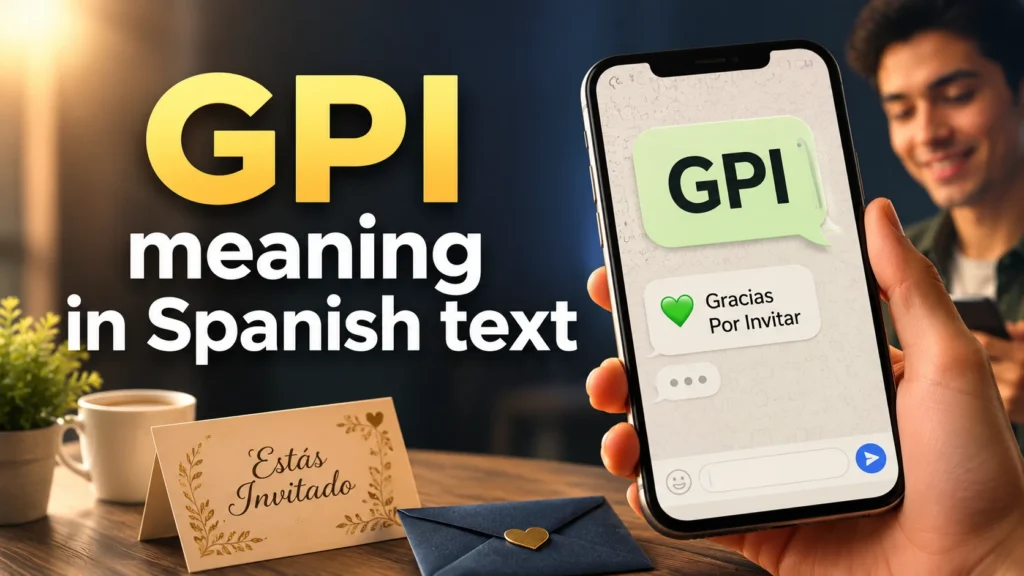
If you have seen someone type “GPI” in a Spanish conversation, comment, or social media post, you may have wondered what those three letters mean. Unlike many English texting abbreviations, GPI comes from a Spanish phrase and is especially common in informal online communication.
GPI usually means “gracias por invitar,” which translates to “thanks for inviting me.” However, there is an important twist: people often use it sarcastically when they were not actually invited.
For example, imagine your friends post pictures from a party you knew nothing about. Someone might comment, “GPI 😂”. They are not genuinely thanking their friends for an invitation. They are jokingly saying, “Thanks for inviting me,” even though nobody invited them.
The expression is popular because it communicates a small feeling of being left out without necessarily turning the situation into a serious confrontation.
Understanding the context is essential because GPI can be playful, sarcastic, affectionate, or occasionally passive-aggressive.
GPI Meaning in Spanish Text – Quick Meaning
GPI = “gracias por invitar.”
In English, the literal translation is “thanks for inviting me.”
In texting and social media, however, the expression often carries an implied meaning:
- “Thanks for inviting me… even though you didn’t.”
- “I see you all went without me.”
- “You could have invited me!”
- “Wow, nobody told me.”
- “I feel left out, but I’m joking about it.”
Simple Examples
“GPI 😂”
Meaning: “Thanks for inviting me,” usually because the person was not invited.
“GPI amigos, qué bonito se ve.”
Meaning: “Thanks for inviting me, friends. Looks beautiful.” The speaker is joking because they were left out.
“Ahh, GPI 😭”
Meaning: “Oh, thanks for inviting me,” with a playful feeling of being excluded.
The exact emotional meaning depends heavily on the relationship between the people and the surrounding conversation.
Origin & Background of GPI
GPI comes from the Spanish phrase “gracias por invitar.” It developed naturally from the way internet users shorten common phrases while texting.
Spanish-speaking social media communities frequently create abbreviations from the first letters of words. GPI fits this pattern perfectly:
G = Gracias
P = Por
I = Invitar
The phrase itself is not new. What became popular was using the abbreviation as a humorous reaction online.
How GPI Became Internet Slang
Social media changed the way people express small emotions. Instead of writing a complete sentence, users can communicate an entire attitude with three letters and an emoji.
A photo of friends at dinner, for example, may receive a comment saying “GPI”. Everyone understands the joke without the commenter having to explain why they feel excluded.
The expression became particularly useful on platforms where short comments and quick reactions are common.
Cultural Influence
GPI works especially well in cultures where teasing among friends is a normal part of communication.
A close friend saying “GPI” may not be genuinely upset. They may simply be playfully reminding the group that they would have liked to be included.
That distinction matters. The same three letters can sound funny between close friends but slightly confrontational when used with someone you barely know.
GPI in Real-Life Conversations
WhatsApp Conversation
Person A:
“Nos juntamos ayer en casa de Luis.”
Person B:
“GPI 😭😂”
Here, Person B is jokingly saying, “Thanks for inviting me,” even though they were not invited.
Instagram DM
Person A:
“Look at these pictures from dinner last night.”
Person B:
“GPI 😭”
The response suggests that Person B noticed everyone went out without them.
TikTok Comment
Person A:
“POV: sales con tus amigos un viernes.”
Person B:
“GPI JAJAJA.”
The commenter is jokingly complaining that they were excluded.
Text Message
Person A:
“Estamos todos en la playa 😎”
Person B:
“GPI, mínimo avisen 😂”
This means something like, “Thanks for inviting me. At least let me know next time.”
The tone is humorous, but there is also a small suggestion that the person would have liked an invitation.
Emotional & Psychological Meaning of GPI
GPI is interesting because it allows people to communicate social exclusion indirectly.
Instead of saying, “You left me out and that hurt my feelings,” someone can write “GPI 😂.”
The joke creates emotional distance.
Why People Use GPI
People may use GPI because they:
- Want to point out that they were excluded.
- Want an invitation next time.
- Are teasing their friends.
- Want to make a funny comment on a post.
- Feel slightly jealous but do not want to sound serious.
- Want attention from the group.
- Are genuinely hurt but are masking it with humor.
The emoji often determines how seriously the message should be interpreted.
For instance, “GPI 😂” is usually playful, while “GPI.” can sound noticeably colder.
A Personal-Style Scenario
Imagine opening Instagram and seeing five of your friends having dinner together. Nobody mentioned the plan to you.
You could confront them directly, but that might make the situation unnecessarily serious. Instead, you comment, “GPI 😭😂.”
Your friends immediately understand the message. So, You noticed. You would have liked to come. You are also keeping the mood light.
That is the social power of GPI.
GPI in Different Contexts
GPI on Social Media
Social media is probably where you will encounter GPI most often.
People use it under photos, Instagram Stories, TikTok videos, Facebook posts, and group pictures.
The comment is usually playful rather than genuinely angry.
GPI Among Friends
Among close friends, GPI can be almost affectionate.
A friend may say:
“GPI, la próxima me llevan.”
This means, “Thanks for inviting me; take me with you next time.”
The person may not actually be offended.
GPI in Relationships
Partners may use GPI jokingly when one person goes somewhere without the other.
For example:
“Fuiste por café y ni me avisaste. GPI 😂.”
The person is playfully saying, “You went for coffee and didn’t even tell me.”
In a romantic relationship, context and tone matter even more.
GPI at Work
Be more careful with GPI in professional settings.
A colleague writing “GPI” in a casual team chat may be joking. In a formal workplace conversation, however, the abbreviation can sound unprofessional or passive-aggressive.
A clearer phrase such as “Please include me next time” is usually better when the matter is genuinely important.
Casual vs. Serious GPI
Casual:
“GPI 😂”
More emotional:
“GPI 😭”
Potentially serious:
“GPI.”
The punctuation and emoji can completely change how the message feels.
When NOT to Use GPI
GPI is informal slang, so it does not belong everywhere.
Avoid It in Formal Communication
Do not use GPI in:
- Formal emails
- Academic writing
- Job applications
- Official complaints
- Professional reports
- Formal customer communication
A professional audience may not know what the abbreviation means.
Be Careful With Cultural Differences
Not every Spanish speaker uses internet slang in exactly the same way.
Some people may immediately understand GPI, while others may interpret it literally or have never encountered it.
If clarity matters, write the full phrase instead.
Avoid It When You Are Genuinely Upset
If you actually feel excluded and want to resolve the issue, GPI may hide the seriousness of your feelings.
Saying “I wish you had invited me” is much clearer than relying on sarcasm.
Common Misunderstandings About GPI
“GPI” Always Means Someone Is Angry
Not necessarily.
It is often just playful teasing between friends.
GPI Literally Means “Thank You for the Invitation”
Yes, but the internet usage often reverses the literal situation.
Someone usually says it because they did not receive an invitation.
GPI Is Always Sarcastic
Not necessarily.
The abbreviation comes from “gracias por invitar,” and context determines whether it is genuine or ironic.
GPI Is an English Acronym
No.
In this context, GPI comes from Spanish words: gracias por invitar.
Anyone Can Use GPI Anywhere
Technically, anyone can type it, but understanding the audience is important.
A close friend is more likely to understand the playful meaning than a formal business contact.
GPI Compared With Similar Expressions
| Expression | Meaning | Typical Tone |
|---|---|---|
| GPI | Thanks for inviting me | Sarcastic/playful |
| Gracias por invitar | Thanks for inviting me | Literal or sarcastic |
| GPI 😂 | Thanks for inviting me 😂 | Clearly playful |
| Ni me invitaron | They didn’t even invite me | More direct |
| Me hubieran invitado | You should have invited me | Direct but casual |
| ¿Y yo qué? | What about me? | Playful or annoyed |
| La próxima me llevan | Take me next time | Friendly |
| Gracias por avisar | Thanks for letting me know | Often sarcastic |
| Qué mala onda | That’s not cool | More critical |
| Nos vemos la próxima | See you next time | Light and accepting |
Key Insight
GPI is less about the literal words and more about the social situation behind them. When someone says it after seeing friends together without them, the hidden message is usually, “I noticed you went without me, and I’m teasing you about it.”
Variations and Types of GPI
1. GPI
The basic form means “thanks for inviting me.”
2. GPI 😂
The laughing emoji makes the sarcasm obvious and softens the complaint.
3. GPI 😭
The crying emoji often exaggerates the feeling of being left out for comedic effect.
4. GPI JAJAJA
Adding “JAJAJA” makes the message strongly humorous.
5. GPI amigos
This directly addresses friends who supposedly forgot to invite the speaker.
6. GPI, mínimo avisen
This means, “Thanks for inviting me; at least let me know.”
7. GPI para la próxima
This suggests, “Thanks for inviting me—maybe next time.”
8. Ah, GPI
A short version that can sound teasing, surprised, or mildly offended depending on tone.
9. GPI 😒
The annoyed-looking emoji can make the message more pointed.
10. GPI jajaja
This keeps the complaint light while clearly communicating that the speaker noticed the exclusion.
How to Respond When Someone Uses GPI
Your response should depend on whether they are joking or genuinely upset.
Casual Replies
“JAJAJA la próxima te avisamos.”
“Perdón 😂 la próxima vienes.”
“Se nos pasó avisarte 😭.”
Funny Replies
“La invitación estaba en camino 😂.”
“Tú también tienes que preguntar JAJAJA.”
“Perdón, fue una misión secreta.”
Mature Replies
If the person seems genuinely disappointed:
“Sorry, we should have invited you. Next time we’ll let you know.”
This acknowledges their feelings without turning the conversation into an argument.
Respectful Replies
If you are unsure whether the person is joking, a neutral response works well:
“Sorry! We didn’t mean to leave you out.”
That gives them space to clarify their feelings.
Regional & Cultural Usage
Western Culture
Spanish-speaking communities in countries such as Mexico, the United States, and Spain may use GPI in social media conversations, especially among younger users.
The exact frequency varies by community and platform.
Asian Culture
Spanish internet slang may appear among Spanish learners, multilingual communities, and people communicating with Spanish-speaking friends.
The meaning remains connected to “gracias por invitar.”
Middle Eastern Culture
Among Spanish-speaking users or international online communities, GPI can function like other social-media abbreviations.
Understanding the surrounding Spanish conversation is more important than geography alone.
Global Internet Usage
Internet slang travels quickly.
A phrase that begins in one online community can become recognizable internationally through TikTok, Instagram, WhatsApp, and other platforms.
Gen Z vs. Millennials
Younger users are often more comfortable with compressed expressions, abbreviations, memes, and ironic communication.
Millennials may understand GPI easily, particularly if they frequently use Spanish-language social media, but usage varies from person to person.
Is GPI Safe for Kids?
Yes, GPI itself is generally harmless slang.
It simply comes from “gracias por invitar” and is commonly used to joke about being left out.
The important factor is context. A child using GPI may be teasing friends, while repeated messages about exclusion could indicate a more serious social issue.
Parents and educators should focus on the conversation surrounding the abbreviation rather than treating GPI itself as inappropriate language.
FAQs About GPI Meaning in Spanish Text
What does GPI mean in Spanish texting?
GPI usually means “gracias por invitar,” or “thanks for inviting me.” Online, it is often used sarcastically when someone was not invited.
Is GPI Spanish slang?
Yes. GPI is an informal Spanish-language abbreviation commonly associated with texting and social media.
Is GPI sarcastic?
Usually, yes, when someone uses it after seeing friends doing something without them. The speaker is jokingly saying “thanks for inviting me” even though there was no invitation.
What does GPI mean on Instagram?
On Instagram, GPI generally means “gracias por invitar.” Someone may comment it under a photo or Story when they notice friends went somewhere without them.
What does GPI mean in English?
The literal translation is “thanks for inviting me.” In internet slang, it can carry the sarcastic meaning “thanks for inviting me—even though you didn’t.”
Is GPI rude?
Not necessarily. Among friends, GPI is usually playful. It can sound passive-aggressive if used with someone you are not close to or when the speaker is genuinely upset.
How should I respond to GPI?
If it is clearly a joke, respond playfully with something like “JAJAJA next time!” If the person seems genuinely hurt, acknowledge it and explain why they were not invited.
Conclusion: What GPI Really Means
The most common meaning of GPI in Spanish text is “gracias por invitar,” or “thanks for inviting me.” Its real internet meaning is often more playful than literal.
When someone writes “GPI 😂” after seeing friends at a party, restaurant, trip, or gathering, they are usually joking about being left out.
The abbreviation works because it says a lot without saying much. Three letters can communicate teasing, disappointment, jealousy, affection, or a simple request to be included next time.
Pay attention to the relationship, emoji, punctuation, and surrounding conversation. Those details tell you whether GPI is a harmless joke or a genuine expression of hurt.
If you understand that difference, you can recognize GPI naturally in Spanish conversations and use it confidently when the situation calls for a little humor.


